The car won’t wake after a long sit at Santa Anita Park. Or the range falls on a climb off the 210 toward Highland Oaks. Either way, you’re in Arcadia with an EV that won’t roll. Charge Pro LA is a referral line for stranded EV drivers. We match you with independent local mobile rescue operators across Los Angeles County.
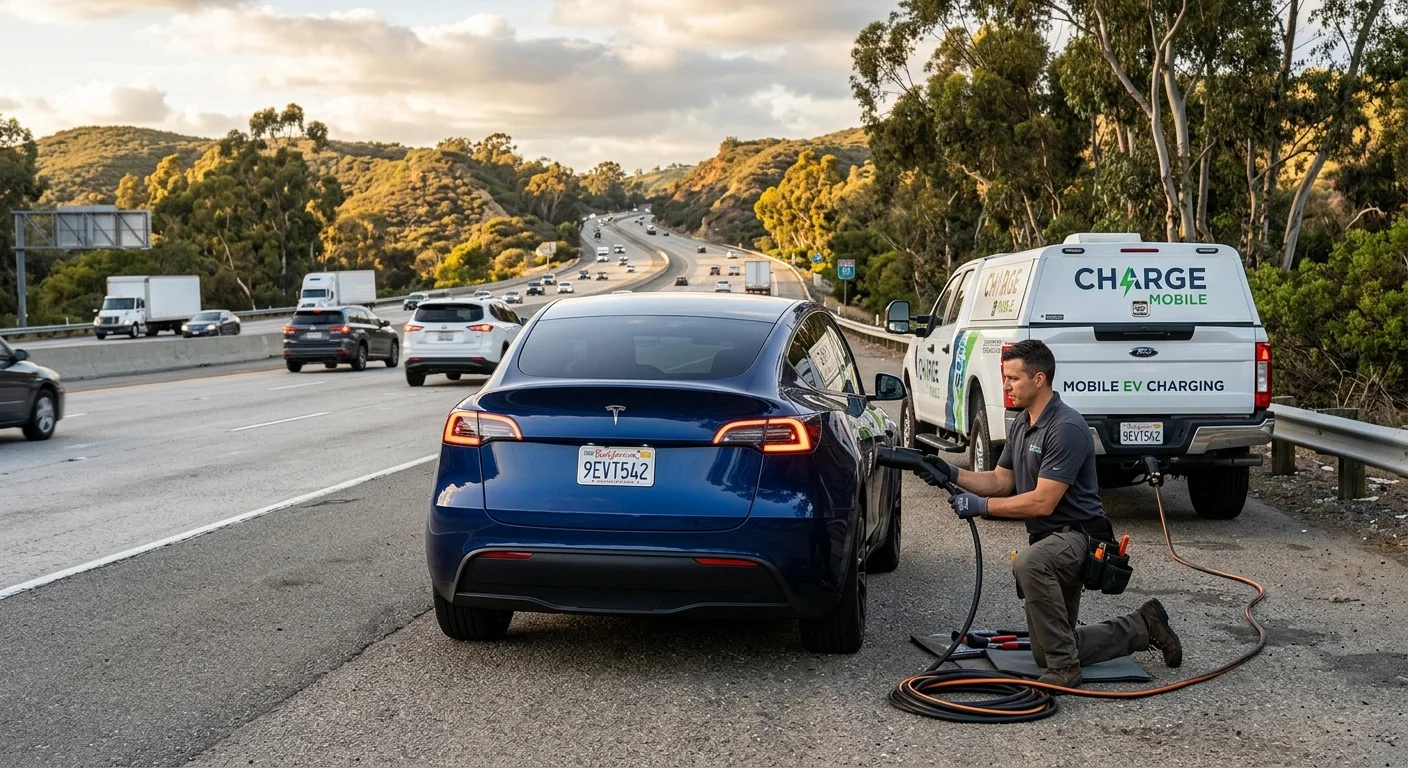
Those operators don’t work for us, and they quote you before they start. They bill you directly for the work. What they bring is a 240-volt Level 2 source. They can also jump or replace a dead 12V on site. Tesla takes a native NACS plug. Other EVs use a CCS or J1772 adapter.
Two failures that look the same from the curb
A black screen at Santa Anita can look like a silent car on the Foothill Freeway. They aren’t the same repair. One is a 12-volt battery that gave up after hours of sitting. The other is a high-voltage pack that ran too low on a grade. Mix them up and you’ll wait on the wrong kind of help.
The small 12V still wakes the computers, locks, and contactors. Tesla and every major EV brand still use one. When it’s flat, the pack can hold miles the car can’t touch. A jump on site restores that wake-up circuit. It doesn’t add range. It turns the key the pack already had.
If the dash never comes up, start with the 12V. Read what happens when an EV 12V dies before you assume the pack is empty. Dead handles, a dark app, and a bricked-looking car all point that way. An empty pack usually still shows a car that’s awake. You’ll see a zero or near-zero number on the display.
Hours in the lot at Santa Anita Park
Santa Anita Park is a long-standing Arcadia landmark. Race days, meets, and long stays keep cars in the racetrack area for hours. The mall district does the same thing a few streets over. Sentry modes, cabin cameras, and a hot afternoon keep the 12V working while you’re inside. You walk back to dead handles and an app that won’t connect.
Don’t assume you need a charger. A dead 12V after a long park is a classic post-event stall. The high-voltage pack didn’t empty. The low-voltage battery did. That can happen whether or not you parked near a plug. Operators we connect you with can jump a Tesla 12V at the stall.
If a private-lot truck is already on the bumper, pause. California Vehicle Code 22658 governs tows off private property. Entrances need the required 17-by-22-inch signage, and the lot needs written authorization. If you return before the car leaves, they have to release it. Storage rates can’t exceed law-enforcement approved rates. Confirm the lot’s process with the venue, and ask before you sign.
Foothill grades off the 210
Arcadia sits in the San Gabriel Valley, at the base of the San Gabriels. About 55,550 people live here per the US Census Bureau ACS 2019-2023 5-year file. The I-210 Foothill Freeway is the east-west spine. SR-19, also called Rosemead, cuts north-south. Huntington Drive still carries old Route 66 through town. Baldwin Avenue and Santa Anita Avenue feed the racetrack and the freeway ramps.
Homes in Upper Rancho and Highland Oaks climb toward the mountains. That pitch costs range. San Gabriel Valley summers run hotter than the coast and cooler than the desert. Cabin AC on a foothill pull adds more load. Recurrent Auto’s published testing shows heat and heavy air conditioning cut real range below the sticker. We don’t have a verified station-level temperature for Arcadia. Treat the window sticker as optimistic on a hot climb.
About 70.4 percent of Arcadia housing was built before 1980, per that Census ACS file. That’s a housing-age fact, not a claim about who has a home plug. A missed overnight charge plus a 210 run is still a common way to leave town already low. Huntington Drive, Baldwin, and Santa Anita Avenue get stop-and-go traffic on event days. A low pack on those streets is a pack problem, not a 12V problem. Say that clearly when you call for EV roadside assistance.
Arcadia is a Clean Power Alliance member city, with Southern California Edison still delivering the power. That split doesn’t change a roadside rescue.
What Metro’s freeway patrol will do on the 210
If you’re already on the Foothill Freeway shoulder, stay put if that’s the safer choice. California Vehicle Code 21718 bars stopping on a freeway. It makes an exception for a disabled vehicle when you’ve summoned help. A stranded EV that has called for assistance fits that exception. California Vehicle Code 21809 is the move-over law. Approaching drivers must change lanes if it’s safe, or slow to a reasonable speed. That protects you, a CHP unit, and a service truck with lights on.
Don’t leave the car unattended for hours. California Vehicle Code 22651 lets an officer remove a vehicle left unattended on a freeway for four hours or more. Stay with it if you can do so safely. Put the hazards on and keep passengers away from traffic.
Metro Freeway Service Patrol roams congested LA County freeways. It’s a joint program of Caltrans, the California Highway Patrol, and LA Metro, and it’s free. Dial 511 and say Motorist Aid. Confirm today’s coverage on metro.net before you count on a truck.
FSP’s published help list is written for gasoline cars. It names a gallon of gas, a radiator refill, taped hoses, and a tire change. It also lists a free tow to a CHP-chosen safe spot. That list doesn’t name mobile EV charging or an out-of-charge boost. That’s an observed gap in the published materials, not a secret FSP policy. An empty EV on the 210 may get a free tow off the lanes. It won’t get a Level 2 charge from FSP based on what Metro and CHP publish.
What a mobile operator actually brings
Charge Pro LA doesn’t own trucks, a yard, or a parts inventory. We don’t employ technicians, and we don’t set prices. We don’t promise when someone will arrive. We connect you with independent local operators who work Los Angeles County. The pros we connect you with are licensed and insured.
The operator quotes you before work starts and bills you directly. What they typically bring is a 240-volt Level 2 source. A typical session adds about 10 to 20 miles of range. That takes 15 to 30 minutes of charging. That window is charging time, not a clock on arrival. If the 12V is the failure, they can jump it or replace it on site. They work Tesla and every major EV brand.
A Level 2 boost is often enough to reach a charger you already planned to use. It can also cover a driveway that can finish the night. A tow still has a place. A car in a live lane may need a flatbed first. A damaged pack may need a shop, not a boost. Weigh those paths in your electric car died: charge it, jump the 12V, or tow it. For an empty pack, ask for mobile EV charging. For a car that won’t power up, say so on the call.
For the local charging picture, use our Arcadia EV charging page.
West to Pasadena, east toward Azusa
Pasadena sits west on the 210. El Monte sits south toward the 10. Alhambra and Monterey Park sit closer to the basin floor. Azusa sits farther east, where foothill grades keep climbing. A stall in Arcadia isn’t a coastal stall. The air is hotter, and the streets pitch up into Highland Oaks and Upper Rancho. The racetrack lots hold cars for hours.
If you rolled out of Pasadena and died at the Arcadia line, you’re still on the same foothill run. Read EV roadside assistance in Pasadena if that’s where the day started. We serve every city in the county.
Name the problem when you call
Tell the person on the line where you are. Santa Anita Park and the mall district are long-sit scenes. A Highland Oaks driveway and the 210 shoulder are different ones. Say whether the dash comes up, and say whether the range hit zero.
Call (858) 925-5546 and we’ll connect you with a local operator. They quote the work. You decide before anything starts.