The climb on San Gabriel Canyon Road spent more pack than the car predicted. You’re coming back into Azusa with the estimate falling. Then it hits zero before you reach Foothill Blvd. That’s the EV roadside assistance problem in Azusa. Foothill grades and canyon runs drain the pack on the way into town.
Why Azusa grades cost more than a basin errand
Azusa sits in the San Gabriel Valley, against the foothills. It runs hotter than the coast, and cooler than the desert. Summer cabin AC is a real range cost. The grades stack on top of that load.
Recurrent Auto’s published heat work ties heavy air-conditioning to lost miles. The window sticker doesn’t model that load. It also skips a long pull on SR-39 at canyon speed.
I-210 is the freeway spine on this side of the valley. Foothill Blvd is Route 66 on the surface. Azusa Ave runs north from town toward the mountains. SR-39 is San Gabriel Canyon Road, the climb toward Crystal Lake. None of those is a flat Westside errand.
Range estimates can look fine in Downtown Azusa. They can look fine in the APU district too. They fall once the road tilts up. That drop is heat, speed, and elevation change. It isn’t a random glitch in the car.
Budget the round trip, not the outbound leg. Check remaining range before you leave the flats. A Crystal Lake day isn’t a grocery loop on Azusa Ave.
The canyon mouth is where the round trip breaks
Azusa is the gate to San Gabriel Canyon. Drivers leave town on SR-39 for Crystal Lake and the recreation above. The climb is the expensive half of the day. Drivers still stall on the way back into the canyon mouth.
The display may have shown enough miles at the turnaround. Extra idling on the return spends those miles. Cabin cooling on a hot valley afternoon spends them too. By the time you re-enter Azusa, that number can already be wrong.
Rosedale, Downtown Azusa, and the APU district all sit on the valley floor. Those streets feel easy after the canyon, but they still cost miles.
If the gauge is already in the red, skip one more hill. Pull off while the car still steers and brakes. A lit lot in town beats a dead stop on the grade.
The same stall happens on the 10 through this valley. Read the notes on a stranded EV on the 10 in the San Gabriel Valley.
If you stall on I-210
A low pack on Foothill Blvd or Azusa Ave still leaves city streets to pull into. The 210 doesn’t give you that.
California Vehicle Code 21718 bans stopping on a freeway. A disabled car is an exception once you’ve called for help. Call 911 first if you’re in a live lane. CHP says a dangerous location is a 911 call.
If you can reach the shoulder, turn the hazards on. Stay out of the travel lanes while you wait. CVC 21809 is the move-over law. Other drivers must change lanes or slow for a stopped vehicle with warning lights.
Metro’s Freeway Service Patrol works congested LA County freeways. It’s a joint program of Caltrans, CHP, and LA Metro. The help is free to the motorist on those routes. Dial 511 and say Motorist Aid for that patrol.
FSP’s published list is written for gasoline cars. It names gas, a radiator refill, a tire change, and a free tow to a CHP-chosen safe spot. It doesn’t list mobile EV charging or an out-of-charge boost. An empty EV sits outside that published list except for the tow.
Hours are typically Monday through Friday peak commute times. Some designated construction zones run all day. Midday and weekend coverage exists on the busiest corridors. Ask 511 what’s running when you call. Don’t treat FSP as a charging truck.
CVC 22651 lets an officer remove a car left unattended on a freeway. The freeway clock in that section is four hours or more. Don’t walk away and hope it sits. Stay with the car if that’s safe. If it isn’t, tell CHP exactly where it sits.
Empty pack, or a 12V that won’t wake the car
An empty drive pack won’t move the car. A dead 12V won’t even wake it. They’re different jobs with different gear. Mix them up and you call the wrong help.
Dark screens and doors that won’t unlatch point at the 12V. Tesla and most other EVs still use a small low-voltage battery. That battery runs the computers and the contactors. Jumping that 12V on site can wake a car that still has range.
If the car is on and the display says zero, that’s pack energy. A 12V jump won’t create miles. You need energy into the high-voltage pack.
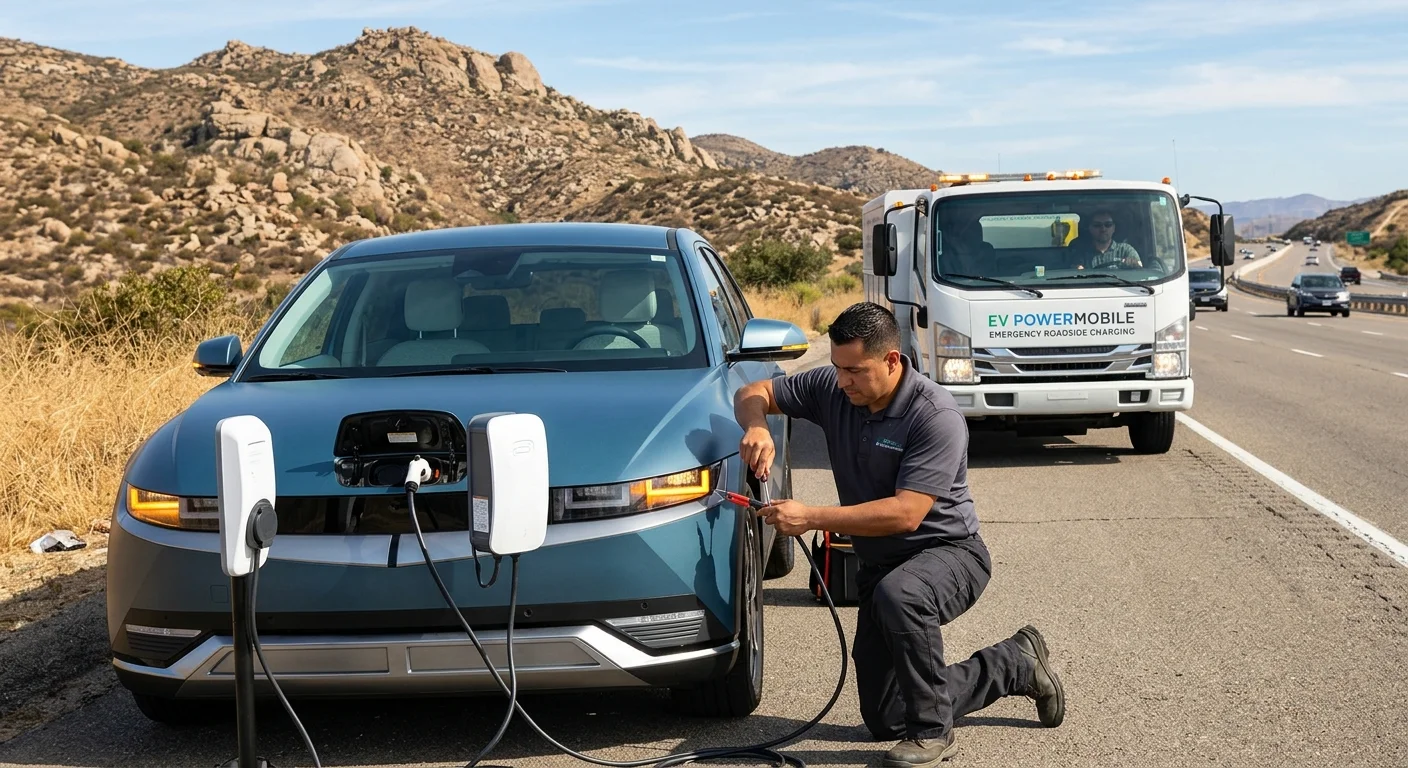
The operators in this network handle both cases. They bring a 240V Level 2 source to the car. Teslas take a native NACS plug. Other EVs use a CCS or J1772 adapter. They also jump or replace a dead 12V on site. They cover Tesla and every major EV brand.
That’s out-of-charge recovery, not a shop visit. The operator quotes you before any work starts. The operator bills you directly after you accept.
Tesla’s own roadside path is the Tesla app. Tesla says out-of-range help may be available. It also says that help isn’t financially covered. A local operator is the backup when that path doesn’t fit.
What a mobile Level 2 boost actually adds
A mobile boost isn’t a Supercharger session. It’s a 240V Level 2 feed at the curb. In this network, that typically adds 10 to 20 miles of range. That comes after 15 to 30 minutes of charging. Those minutes are charge time on the car. They aren’t a promise of when someone arrives.
Ten to twenty miles is often enough to reach a stall you already picked. It can also get you home in Azusa if you were close. It isn’t a full fill of the pack.
The U.S. DOE Alternative Fuels Data Center puts Level 2 at 240V in typical homes. Output varies by the operator’s equipment. It also varies by what the car will accept. Charge time depends on state of charge, pack size, and the onboard charger. The independent operator has to confirm your make, port, and adapter before quoting.
Charge Pro LA is a referral line, not a shop. It matches stranded drivers with independent local mobile rescue operators. It performs no work on the car. It owns no trucks and no yard. It sets no prices for the visit. It promises no arrival time on the call. It holds no license for the trade. The mobile EV charging pros we connect you with are licensed and insured.
Ask the operator to confirm Tesla versus CCS versus J1772 on the call. Don’t assume every operator has every adapter.
Charge where you sit, or take a tow
A tow is the last clean option for an empty EV, not the first. A dead EV on a flatbed still needs a charger at the far end. You also need a driver who knows how to load an unpowered EV.
On the 210, FSP may already offer that free tow to a safe spot. CHP chooses that drop location, not you. That drop may not be a charger. You’d still need a charge after you land.
On Azusa Ave or Foothill Blvd, charge in place. A lot near the APU district works the same way. You drive it off under its own power. For an empty pack, that’s the cleaner path.
Private lot tows follow CVC 22658, including the entrance-sign rules. California doesn’t set one statewide tow price. Confirm any tow quote before you agree.
When a stalled EV needs a charge instead of a tow, start with location. Ask whether the 12V is alive, and whether the pack is actually empty. Don’t guess a cheaper path than the quote. The operator’s quote is the only number that counts.
Older Azusa houses and a dark driveway
Census figures show 69.3 percent of Azusa housing was built before 1980. A 1980-era panel wasn’t designed around today’s Level 2 home chargers. Azusa Light and Water is the city’s municipal utility, not LADWP or Southern California Edison. A named EV rebate or EV rate couldn’t be confirmed on azusalw.com. Check Azusa Light and Water before you assume a home-charger incentive. If the home plug isn’t an option tonight, the roadside call moves the car.
Glendora sits next door on the same foothill line. West Covina, Arcadia, El Monte, and Pomona sit on the valley floor around you.
When to call, and what to say
Make the call when the car won’t move. Make it when you won’t make the next plug either. Waiting on a dark shoulder doesn’t add range. Give the exact street, not just the city. Canyon mouth, I-210 shoulder, a Rosedale driveway, and an APU lot are different jobs. Say whether screens are on, the percent, and the plug type. If you’re on the freeway, say that first.
The operator quotes before starting, then bills you directly. Charge Pro LA serves every city in Los Angeles County. Call (858) 925-5546 and we’ll connect you with a local operator.