A Honda Prologue can sit dark after a night in an older apartment garage. That’s usually a 12V failure, not an empty pack. The traction pack can still hold a commute. The small battery under the hood is what wakes the car. When that 12V sags, the Honda ignores the fob. A tow is the wrong first call.
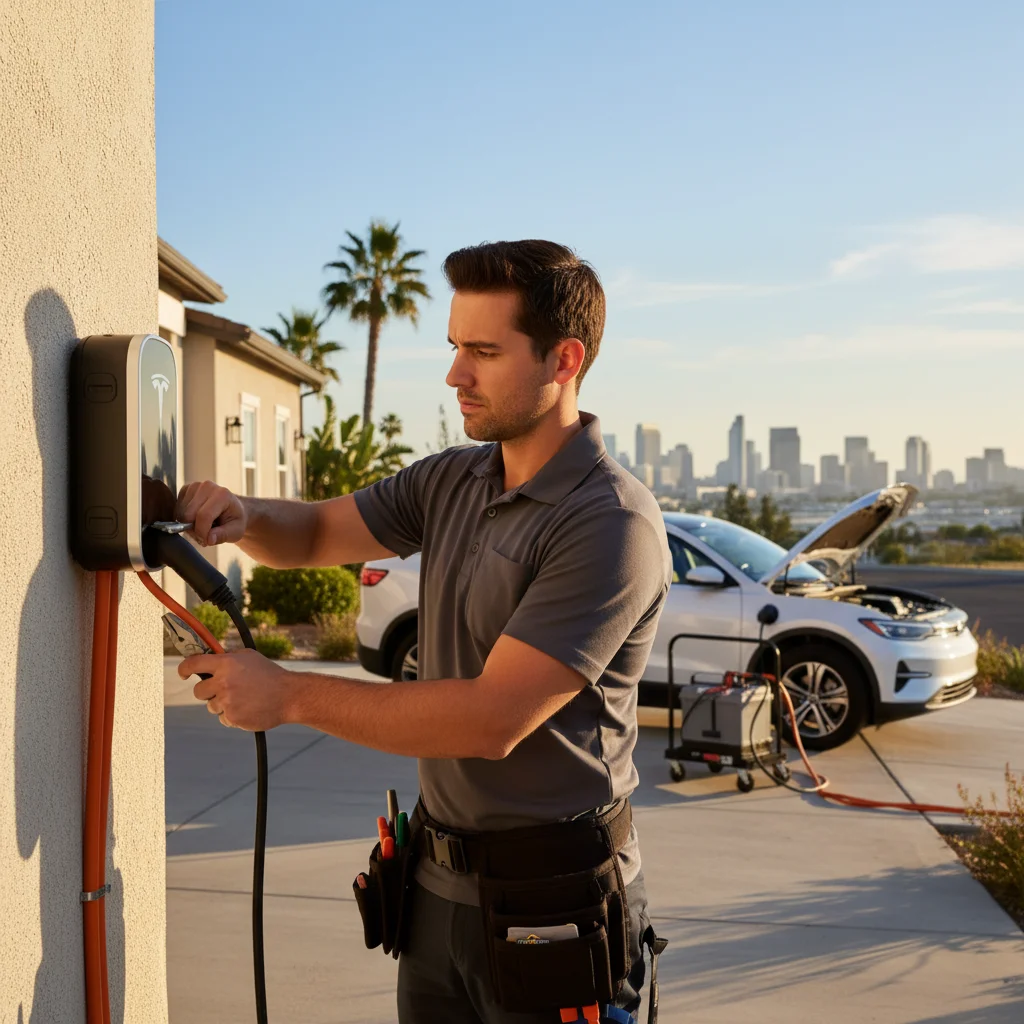
Older Los Angeles County garages make this more common
A lot of the county’s housing predates modern EV circuits. U.S. Census ACS 2019-2023 figures put pre-1980 housing at 71.0 percent in the City of Los Angeles. East Los Angeles is 86.2 percent. Whittier is 88.9 percent. Culver City is 85.5 percent. West Hollywood is 80.5 percent. Long Beach is 79.6 percent. Those buildings often mean shared garages and 120-volt wall outlets. Many panels were never sized for a dedicated Level 2 charger.
The overnight story is simple. You plug into a regular garage receptacle. You assume the Prologue took energy. A session can stop without a loud warning. The 12V keeps feeding modules until morning. You come downstairs to a silent Honda.
LADWP serves the City of Los Angeles. Southern California Edison delivers power across much of the rest of the county. Culver City, Santa Monica, West Hollywood, and Redondo Beach buy generation through Clean Power Alliance. SCE still runs the wires and reads the meter. That split doesn’t change a dead 12V. It only changes who you call later about a home circuit. If the garage panel is the long-term problem, start with old electrical panel, no home charger: when mobile charging is the backup.
Newer tracts in Santa Clarita and Stevenson Ranch have far less pre-1980 stock. A Prologue still bricks there after a long vacation sit. The older-garage version shows up more on the Eastside, in the Gateway Cities, and in South Bay apartments.
The 12V is the switch. The pack is not.
The Prologue won’t start on traction-pack energy alone. The 12V runs the locks, the dash, and the computers. It also runs the relays that close the high-voltage contactors. If the 12V is dead, those contactors stay open. Ready never comes on. The charge port often stays shut. The fob looks broken.
Honda built the Prologue on GM’s Ultium platform. The Acura ZDX is the mechanical twin. The Chevy Blazer EV and Equinox EV use the same basic architecture. Same 12V dependency. Same dark-car trick with a full pack. Checks that wake a ZDX in a Westside garage apply to the Honda too.
The deeper electronics explanation is in when an EV 12V dies.
This research didn’t turn up a verified service-life figure for the Prologue’s 12V. Don’t guess years from a forum. If the battery is original and the car sat, treat it as the first suspect. A Honda dealer or an independent shop can test it once the car is awake.
Dark garage versus zero range versus a charge fault
Sort the problem before you spend the morning on a tow.
A weak or dead 12V usually looks like this:
- Dash, cabin lights, and infotainment are dim or fully out
- The fob used to work from across the lot and now needs to be on the handle
- The car sat more than a couple of weeks without a drive or a plug
- The charge-port door and the door locks ignore the fob
- You press the brake and hear no clicks from the relays
Some dash light with no Ready state is a 12V on the edge. A fully black cabin is a 12V that’s likely flat.
An empty traction pack is a different car. The displays still come up. You may get Ready. Range sits at or near zero. That’s energy, not a failed wake-up.
A charge-session fault is the third pile. The dash is awake. A public stall shows connected, then stops. Ultium quirks show up on the Blazer EV and Equinox EV the same way. A different stall, or shade while the car cools, often clears it. That isn’t the silent morning brick in a Culver City or Alhambra garage.
If the connector won’t unlatch after a session, stop pulling. Use the stuck charge-port guide.
What you can check before you call a tow
Confirm park. Confirm you have the correct fob. If the doors won’t move, use the physical-key path in the owner’s manual.
Read the dash. No display at all points at 12V. A bright cluster with zero miles points at the pack.
Don’t keep retrying a wall outlet if the port door won’t open. You can’t charge through a dead 12V.
Stay off the orange high-voltage cables. Those aren’t jump points.
Jump the 12V. Leave the Ultium pack alone.
The Prologue keeps its 12V under the hood, in roughly the same place as a gas Honda battery. Labeled jump posts are there for this. Open the hood if the interior release still works. If it doesn’t, the manual has the emergency release for your model year.
A portable 12V jump pack is the clean tool. A gasoline donor car also works. Clip to the labeled positive and negative posts only. You’re waking the small battery. You’re not feeding the drive pack.
Keep the safety list tight:
- Use only the labeled 12V jump points
- Never clip onto orange high-voltage cables
- Don’t jump from another EV’s drive battery
- Once the dash wakes, leave the car powered for a few minutes before you pull the clamps
The walkthrough that applies across EVs is how to jump start an electric car without damage.
A jump can get you to a shop. If the 12V is finished, the car can go dark again after the next sit. That’s a replacement, not a second lucky jump. Independent operators in this network jump or replace a dead 12V on site. They quote before they start. They bill you directly.
When the pack is actually empty
If Ready is on and range is gone, you need energy in the Ultium pack. Drive to a public stall if you can do it safely. If you’re boxed into a garage aisle, an on-site Level 2 boost is the other path.
Charge Pro LA is a referral line. It matches stranded EV drivers with independent local mobile rescue operators. It performs no work, owns no trucks, and employs no technicians. It sets no prices and promises no arrival time. It holds no trade license. The operator who takes the job quotes you before starting and bills you directly.
That operator brings a 240V Level 2 source to the car. For a Prologue, the operator uses a CCS or J1772 adapter. Typical charging time adds about 10 to 20 miles of range in 15 to 30 minutes. That figure is charging time only. It isn’t a promise of when someone arrives.
Non-Tesla EV rescue is the page for this Honda. If the pack is the empty part, out-of-charge recovery is the matching job. The same operators handle Tesla and every major EV brand.
When you call, say whether the dash is dark or at Ready with zero miles. Say whether the fob works, and whether you already tried a jump.
Freeway shoulder, airport garage, private lot
If the Prologue died on a Los Angeles County freeway, California Vehicle Code 21718 generally prohibits stopping there. A disabled vehicle that has already summoned help fits a stated exception. Stay with the car if it’s safe. Use hazards. California Vehicle Code 21809 is the move-over law. Approaching drivers must change lanes if they can, or slow around a stopped service vehicle with flashing lights.
Metro Freeway Service Patrol is a free joint program of Caltrans, CHP, and LA Metro. Dial 511 and say Motorist Aid. Confirm current hours on metro.net. FSP’s published list names a gallon of gas, a tire change, and a free tow to a CHP-chosen safe spot. It doesn’t list mobile EV charging. An empty or dark Prologue is outside that published list, other than the tow to a safer place.
Private apartment garages add a tow clock. California Vehicle Code 22658 covers tows from private property. The lot needs 17-by-22-inch signs at the entrances, plus written authorization. If you return before the car leaves the lot, they have to release it. A statewide rate cap wasn’t confirmed here. Confirm the lot’s posting and the city’s current rules. A dark Prologue in a West Hollywood or Culver City garage can get hooked while you wait for a jump.
Airport parking produces the same 12V surprise after a trip. Los Angeles International has Level 2 and DC fast charging in terminal structures P1 through P7. The Economy Parking garage has more than 4,000 stalls, including 514 active EV chargers, per LAWA pages read on 2026-09-18. A week in that garage can still kill the 12V. Chargers in the structure don’t keep a tired 12V alive while the car sits off. Hollywood Burbank, Long Beach, and Van Nuys follow the same sit-and-die pattern. Charger counts at those three fields couldn’t be confirmed here. Check each airport’s own parking page before you plan around a plug.
Frequently asked questions
Why won’t my Honda Prologue start if the pack is charged?
The traction pack doesn’t wake the car by itself. The 12V powers the modules that close the high-voltage contactors. If that small battery is dead, the Prologue stays dark. It often won’t unlock or charge either. A labeled 12V jump is the usual first step, even after a night on a garage outlet.
Can I jump a Honda Prologue the way I’d jump a gas Honda?
You jump the 12V only. The battery sits under the hood with labeled posts. A jump pack or a gas donor car is the right tool. Never clip onto orange high-voltage cables. If the hood release is dead, use the emergency steps in your owner’s manual. Another EV’s drive pack isn’t a donor.
Is the Honda Prologue the same car as the Acura ZDX?
On the mechanical side, they’re twins on GM’s Ultium platform. The Chevy Blazer EV and Equinox EV share that architecture too. The 12V layout, the no-start pattern, and a lot of the charge-fault behavior carry across those models. A fix that wakes a ZDX is the same family of fix on a Prologue.
Charge Pro LA doesn’t perform the work. We serve every city in Los Angeles County. Call (858) 925-5546 when you want a local operator match.