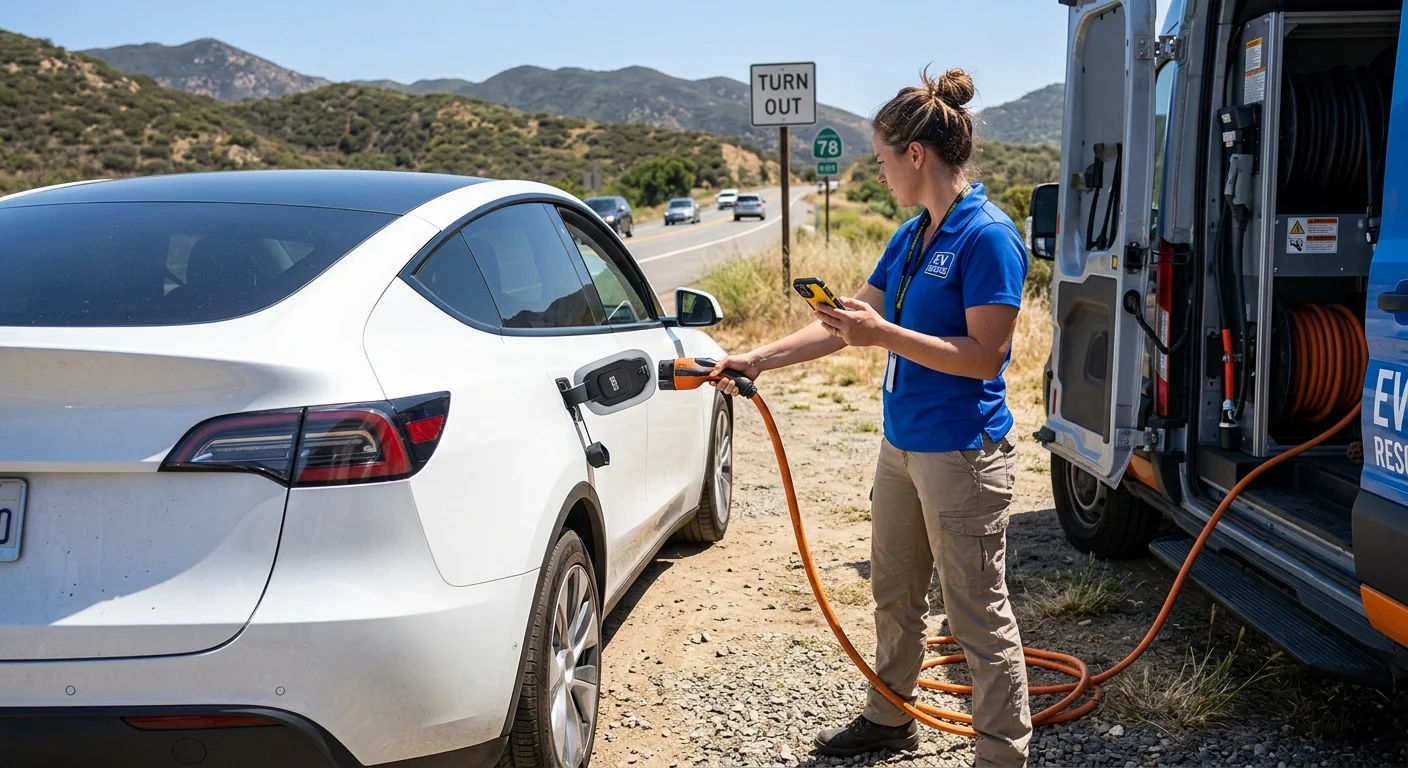
Your EV just hit zero on the 14 near Acton. Stay clear of live traffic if you can do it safely. Then pin the exact spot on the Antelope Valley Fwy grade. Read every dash warning aloud, word for word. A local operator then picks a mobile Level 2 boost or a tow.
The 14 climb through Acton is its own problem
Acton sits in the Antelope Valley at over 2,000 feet. About 7,721 people live across roughly 39 square miles of ranch country. The community strings along the SR-14 climb between Santa Clarita and Palmdale. Acton is the small high-desert stretch between those two. It’s a long empty grade with ranch land on both sides.
Sierra Hwy runs through the same corridor as the freeway. Crown Valley Rd and Escondido Canyon Rd drop you onto that belt. Vincent is a named area along the route. The Agua Dulce edge sits on the same stretch. Say the name exactly as the sign prints it.
High-desert weather works against the pack on this climb. Summer heat runs into triple digits. Winter nights can sit near freezing. Cabin AC or heat then runs almost constantly. Recurrent Auto’s published tests show EVs keep about 78% of range at 32F. Heat and heavy air conditioning cut range too. A charge that felt fine in Santa Clarita can sag hard before Palmdale.
Our Acton EV charging page covers the same high-desert pocket.
Handle the scene before you talk charging
Live traffic is the first problem, not the battery. If you’re already out of traffic, say where the car sits. If you’re still in a travel lane, describe that before anyone plans a boost.
California Vehicle Code 21718 bans stopping on a freeway in most cases. A disabled EV that’s already called for help fits a written exception. If anyone is hurt or the car is in immediate danger, call 911. This page can’t tell you to stay inside, get out, or cross a lane.
Metro Freeway Service Patrol is a free program on congested LA County freeways. Caltrans, CHP, and LA Metro run it together. Dial 511 and say Motorist Aid. FSP can offer a gallon of gas or change a flat. It can also tow a disabled vehicle to a CHP-chosen safe spot. Its published motorist list doesn’t name mobile EV charging. An empty traction pack sits outside that menu.
CVC 21809 is the move-over law. Drivers must change lanes or slow for flashing lights on a stopped service vehicle. CVC 22651 lets an officer remove a vehicle left unattended on a freeway. The unattended-freeway window in that section is four hours. Call for help before that clock becomes the plan.
Don’t assume a ranch driveway or a Sierra Hwy turnout is still in range. A car at true zero may not complete another move. Report whether it still selects drive, steers, or releases the parking brake. Skip those tests if they’d put anyone in traffic.
If an officer is already there, tell the operator. Share any order to move or leave the car. That can close the door on a roadside charge.
Pin one spot, not a whole town
“Near Acton” is too big a search box. An operator needs the place the tires actually stopped.
Read the nearest sign. Then send:
- SR-14 or Antelope Valley Fwy, plus northbound or southbound
- Sierra Hwy, Crown Valley Rd, Escondido Canyon Rd, or another named road you can see
- Vincent, the Agua Dulce edge, or any labeled area on a sign
- A phone map pin and a screenshot that shows the freeway and the nearest cross road
- Shoulder, turnout, ranch driveway, or private land
- Which side of the 14 you’re on, and which way the car faces
If the map pin and the roadside sign disagree, send both. Don’t guess a mile marker. A pin can land on the opposite side of a median. Mention fences, closed gates, dirt berms, and separate ranch driveways. Those details change the last hundred feet.
If you still had range when the warning hit, act before you stall. Once you’re stopped, stay with this scene. The same north-county empty-pack pattern shows up on the 5 near Santa Clarita. The 14 climb is a different grade.
Empty pack and a dead 12V are different jobs
A silent EV hasn’t diagnosed itself, so copy the dash wording.
Tell the operator:
- The percent or miles still on the display
- Any out-of-energy wording
- Any low-voltage or 12V warning
- Whether the main screen stays awake
- Whether the doors and charge port still respond
- Any charging or system-fault alert
Open the vehicle app if it still connects. Screenshot the warning so the wording doesn’t vanish.
A dead 12V can freeze the car with miles still in the pack. An empty traction battery is a charging job. Don’t pop covers or try a jump from a gas truck on a guess. Independent local operators handle Tesla and every major EV brand. They can jump or replace a 12V on site. They can also bring a 240V Level 2 lead if the pack is empty.
Charge Pro LA doesn’t inspect the car and doesn’t do the work. We connect you with licensed, insured local operators. Give them the make, model, year, and the exact dash text.
Explain the last hundred feet of access
A perfect pin still doesn’t prove a charging truck can park by the port. Acton’s ranch gates and freeway turnouts make that last approach the real question.
Say whether the EV is:
- Beside a live lane on the 14
- In a marked turnout
- Behind a gate on private ranch property
- Under a height limit or inside a garage
- Nose-in or nose-out from the only approach
- Blocked by another vehicle, a fence, or a berm
Mention space at the charge port and which side it sits on. Don’t shuffle the car just to make room unless the scene is safe. Wait for the operator or an officer if you’re unsure.
Locked doors, crash damage, or a wheel that won’t roll change recovery. If you’re on private land, say whether you can let the operator in. California Vehicle Code 22658 governs tows from private property.
Ask the operator to confirm the plug before anyone rolls. Teslas take a native NACS lead. Other EVs may need CCS or J1772. The U.S. Department of Energy charging guide explains levels and connectors. Confirm output with the person doing the work.
Charge Pro LA forwards your details. We don’t set price, equipment, or whether the site works. The operator quotes you before starting and bills you directly.
Let the operator pick a boost or a tow
A mobile Level 2 charge is one recovery path, not the automatic one. The operator has to confirm the car can take energy where it sits.
Ask them to confirm:
- Whether a roadside charge matches the symptoms you reported
- Whether their connector fits your EV
- Where the equipment would stand on this grade
- What output they can actually deliver
- Whether a tow is the cleaner recovery
Operators on these calls bring a 240V Level 2 source to the car. That boost typically adds 10 to 20 miles of range in 15 to 30 minutes of charging. That’s plug time only. It isn’t a promise of when anyone arrives. If the 12V is dead, they can jump or replace it on site.
Don’t assume a set range or a set session length. The truck and your car both limit output. Agree on the goal before they plug in. How mobile rescue trucks work explains the equipment without guessing your turnout.
Transport belongs in the conversation when the car won’t accept a charge. It also belongs when another fault remains, or the stopping place isn’t serviceable. The tow outfit should confirm loading method, destination, and price. We don’t set those terms.
If charging is the plan, name the next stop with the operator. That might be home in Acton. It might be a public stall you can verify in Palmdale or Lancaster. Check live status before you treat a map icon as a reservation. Out-of-charge recovery is the referral path for that on-site decision.
Drivers headed toward Palmdale stay on the same 14. Our Palmdale EV rescue notes cover that end of the freeway.
When to call Charge Pro LA
Call when the EV has stopped on the 14 near Acton. You need a local operator to weigh a charge or a tow. Charge Pro LA is a referral line. We don’t own trucks, and we don’t perform the recovery.
Call (858) 925-5546 and we’ll connect you with an independent local EV rescue operator.