A Chevy Equinox EV won’t start in a parking structure for a simple reason. It’s usually a dead 12V, not an empty Ultium pack. The small battery under the hood wakes every computer. The drive pack can’t engage until those computers boot. You can leave with range still on the display. You may return to a dark cabin. The fob stays silent. The car won’t shift.
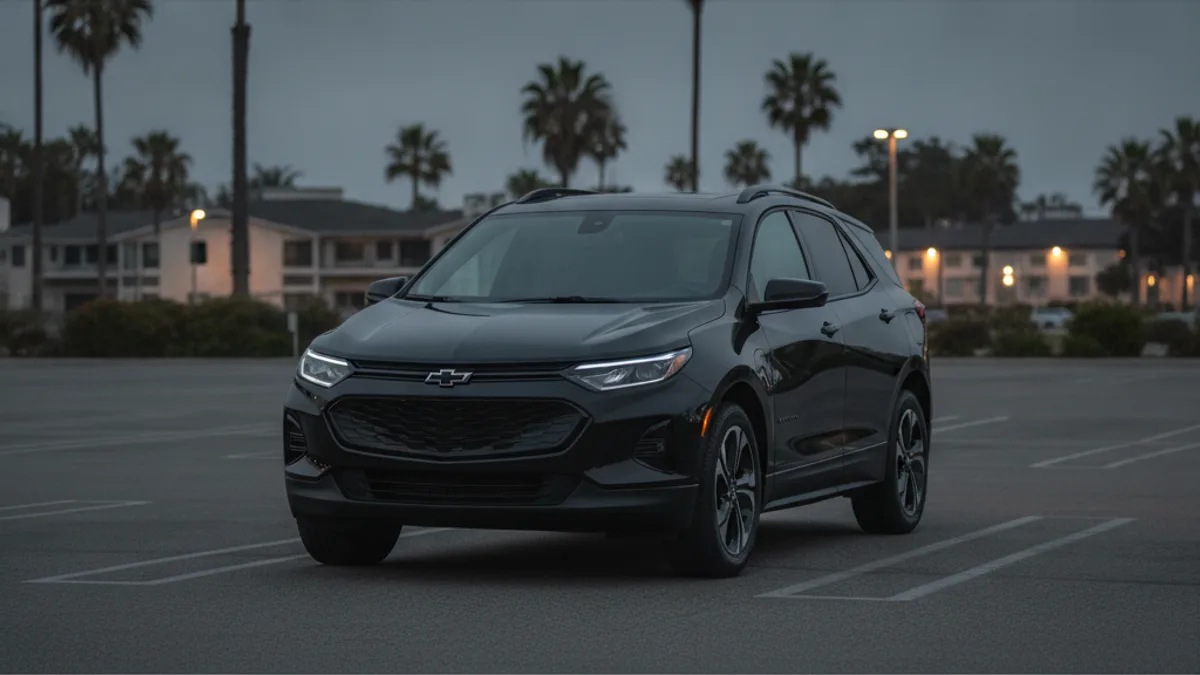
A garage can hide the failure until you can’t wake the car
Downtown Los Angeles is stacked parking. Office decks, hotel basements, and campus structures swallow cell signal. Your Chevy app may not refresh at the stall. A low-voltage warning you never saw stays on a screen you can’t open. You learn the car is dead only when you’re already there.
That sit is a classic 12V killer. Accessory drains add up while the car looks asleep. Heat in a closed structure ages an AGM battery faster than an open street. You walk back from a meeting at USC, near downtown. The Equinox EV does nothing. The last drive felt fine. The pack was never the part that failed.
Airport parking writes the same story at a longer scale. At Los Angeles International, terminal structures P1 through P7 offer Level 2 charging. They also offer DC fast charging. Some stalls take a reservation, and others are first-come. The Economy Parking garage has more than 4,000 stalls, including 514 active EV chargers. Those plugs don’t protect the 12V. A traveler can return from a week away and still find a brick. Confirm current stall details on parking.flylax.com before you rely on a specific level.
Griffith Observatory and Universal Studios Hollywood create the same long sit. You’re away from the car for hours. Signal in the structure is poor when you return. Hollywood Burbank, Long Beach, and Van Nuys airports see the same 12V-after-a-trip pattern. Charger counts at those three fields weren’t verified here. Check each airport’s own site for parking details.
Metro’s Freeway Service Patrol won’t meet you on a parking level. That program is free, and it roams congested Los Angeles County freeways. It can offer a gallon of gas. It can tape a hose and change a tire. It can tow a disabled vehicle to a CHP-chosen safe spot. Dial 511 and say Motorist Aid if you’re on a freeway. The published help list doesn’t name mobile EV charging. A dark Equinox EV on private garage concrete sits outside that patrol.
Tell an empty pack from a car that won’t power on
Don’t mix these two failures. They ask for different help.
An Equinox EV that ran the pack down usually still wakes. You get a dash. You get a low-range warning. You can often shift to drive. You just won’t go far. If that’s your car, you need energy in the Ultium pack. Independent operators can bring a 240V Level 2 source to a Chevy. They typically add 10 to 20 miles of range. That’s in 15 to 30 minutes of charging. That’s charging time, never an arrival time. They use CCS or a J1772 adapter on non-Tesla EVs. For the garage version of that job, read mobile EV charging in downtown Los Angeles.
A dead 12V gives you nothing. No chime. No screens. No fob handshake. The car won’t go to Neutral. People assume the main pack died because the whole vehicle feels dead. The Ultium pack can still be healthy. It’s waiting on the 12V to boot the brains. That’s the pattern behind what happens when an EV 12V battery dies.
If the car powers on but a public stall won’t feed it, stop. Use the Chevy Equinox EV won’t charge steps instead. A charge-port fight and a silent cabin are different problems.
Checks to run before you call a tow
Start with the cheap tests. Don’t wave in a hook from the cashier booth yet.
Look at the dash through the windshield. Any glow means the 12V still has some life. No glow means you’re in lockout territory. Try the fob from a few feet, then from the liftgate. Walk toward a ramp, a stair, or daylight until you have signal. Open the Chevy app if it will connect. You’re looking for a low-voltage alert you missed, not a range number.
If the app is blank and the car is blank, treat it as a 12V. Don’t keep tapping the start button. Don’t try to bump-start it. There’s no engine to catch. Don’t run jumper cables from another EV hoping to fill the pack. Cables move 12 volts. They don’t charge an Ultium battery.
Then use the Equinox EV’s own backup path. The fob hides a mechanical key blade. Press the release and pull the blade free. On this model the blade isn’t for the driver’s door. It’s for the liftgate. That trips people in a dim aisle. Most EVs put the override at a front door. This Chevy doesn’t.
Walk to the rear. Use the blade in the liftgate’s mechanical lock. When the liftgate opens, climb in from the back. Find the interior hood release and pop the front hood. You’re only opening panels. You’re not rolling the car. In a tight downtown lane, a rolling Equinox EV is a bad night for everyone.
If the blade won’t turn, stop. If you can’t reach the hood release, stop. Forcing a lock in a parking structure can damage the latch. You’ll still be stuck.
Where the 12V sits and how to jump it
The 12V is a maintenance-free AGM battery under the front hood. After the liftgate entry, you should see the jump points. A metal cage or bracket sits over the battery. Owners commonly describe four 10mm nuts holding that cage. The cage can block a clean grab on the negative post. You don’t need to unbolt it for a normal jump.
Clamp the positive jumper lead to the positive terminal. Clamp the negative lead to bare, unpainted chassis metal. Don’t clamp the negative lead to the battery’s own negative post. That chassis ground is the intended path.
Some owners with a small jump pack change the hookup order. They keep the car’s own positive lead out of the circuit at first. That can help a weak pack wake the modules. Once the car is up, the DC-DC converter takes over. It recharges the 12V from the Ultium pack while you drive. Don’t shut it down in the same stall and hope. Drive it. Get the 12V tested once you can drive.
If the car feels glitchy rather than fully dead, try a reboot before a jump. Disconnect the 12V negative terminal for about 10 minutes. Let every module power down. Reconnect, then see if the car wakes. That’s cleared a no-power complaint for some owners with no jump at all. For clamp order and the safety basics, follow how to jump start an electric car. A dark structure is a poor place to guess at studs. Painted brackets and the wrong ground can spark and do nothing. If a clean jump still leaves a dark car, you’re past DIY.
When a jump isn’t the real fix
Some Equinox EV owners have reported a software drain on the 12V. A failed or interrupted update can leave the car unresponsive in a similar way. Dealer work on those cars has often included a new 12V plus a reprogram. A parking-lot jump won’t finish that job.
A 12V that dies again in a few days isn’t asking for another jump. That pattern points at the DC-DC converter or an ongoing drain. Get it tested. An EV 12V that dies again after a jump is a warning, not a coincidence.
Heat speeds the wear. Inland lots in the San Fernando Valley cook a parked Equinox EV through the afternoon. The San Gabriel Valley does the same. Pasadena, Glendale, and Burbank sit in that hotter inland pattern. Coastal cars on the Westside aren’t safe either. Short hops around Santa Monica or Culver City can leave the 12V undercharged. Neither climate is a defect in the Ultium pack. Both are hard on the little battery that boots the car.
A dead car in a garage can get towed
A parking structure is private property. California Vehicle Code 22658 sets the rules for removing a vehicle from private property. The lot needs the required 17-by-22-inch signage at the entrances. The owner or an agent must give written authorization. The tow company must give immediate written notice to the registered owner. Local law enforcement must be notified within one hour.
If you get back before the car leaves the lot, they have to release it. If it’s coupled but not yet moved, you pay at most half the tow charge. Storage can’t exceed rates approved by law enforcement or the CHP. California doesn’t set one statewide tow-rate cap. Confirm the current figure with the lot and the tow company before you pay. A number you guess from another city is useless here.
In the City of Los Angeles, official impounds run through the Official Police Garage system. Release steps and fee schedules weren’t confirmed against lapdonline.org in our research. Check lapdonline.org or lacity.gov before you assume a process or a price.
This is why a dead Equinox EV downtown is a time problem. It isn’t only a battery problem. You may have no signal at the stall. Walk toward a portal or the exit until you can place a call. Tell the attendant the car is disabled and you’ve summoned help. Ask them not to hook it if you’re already heading back to the stall.
On a freeway the rules differ. CVC 21718 generally bans stopping on a freeway. There’s an exception for a disabled vehicle when help has been summoned. CVC 21809 is the move-over law for flashing lights. Those statutes matter on the 10, the 110, and the 405 through Sepulveda Pass. They don’t replace 22658 inside a garage.
If you stalled on the 110 ExpressLanes, Metro requires a FasTrak transponder. A vehicle without one is billed by plate under Pay-As-You-Go. Disabled-vehicle procedure inside the ExpressLanes wasn’t confirmed on Metro’s published FAQ. Don’t assume a usable shoulder on that corridor.
Gated exits make a 12V failure worse. A ticket arm needs the car to move. A pay kiosk at the ramp doesn’t help a cabin with no power. That’s the Universal Studios parking problem in miniature. If you’re stuck in that structure, dead EV at Universal Studios covers how to leave. Downtown decks have the same arm, the same height limit, and the same dark stall.
When to get a local operator on site
Call for help if any of this is true. The key blade won’t open the liftgate. You can’t reach the hood release. You have no jump pack and no safe chassis ground. The car died again after a clean jump. You’re in a gated structure and the car won’t roll to the exit. You’re worried the lot has already called a hook.
Charge Pro LA is a referral line for Los Angeles County. It matches stranded EV drivers with independent local mobile rescue operators. The brand doesn’t own trucks, employ technicians, or hold a trade license. It doesn’t set prices or promise an arrival time. The operator who takes the job quotes you before starting and bills you directly.
What those operators do is specific. They can jump or replace a dead 12V on site. They can bring a 240V Level 2 source to the car. Native NACS is for Teslas. A Chevy Equinox EV needs CCS or a J1772 adapter. They handle Tesla and every major EV brand. The pros we connect you with are licensed and insured.
We serve every city in the county. That includes downtown Los Angeles, the Westside, and the valleys. It also includes the South Bay and the Antelope Valley. If your Equinox EV is dark in a parking structure, tell the operator the level. Name the nearest stair. Say whether the car will roll. For a non-Tesla that’s stuck, start with non-Tesla EV rescue. Call (858) 925-5546 and the referral will pass you to an operator.
Frequently asked questions
Why won’t my Chevy Equinox EV start?
A weak or dead 12V is the usual cause, not the Ultium pack. The 12V has to boot the computers before the high-voltage system can work. A healthy pack still leaves a dark car if that small battery is gone. Some drivers get a warning first. Others get nothing until the fob goes silent in a garage.
How do I get into a locked Equinox EV with a dead 12V?
Pull the mechanical key blade from the fob. Use it in the liftgate lock at the rear, not the front door. Climb in from the back and pull the interior hood release. That’s how you reach the 12V under the front hood.
Can I jump a Chevy Equinox EV in a parking garage?
Yes, using the positive terminal and a bare-metal chassis ground. Don’t use the battery’s own negative post. A cage over the battery can hide that negative post. Leave the cage on for a standard jump. If a jump fails, or the 12V dies again, stop. Get a dealer diagnosis or a mobile operator on site.