On the 10 or the 405, start with one fork. Either the traction pack is empty, or the 12-volt battery failed. That’s the EV battery type split that actually moves the next call.
What EV battery types actually mean on the shoulder
Most people who search EV battery types mean cell chemistry. They compare LFP packs, nickel-based packs, and 12-volt lithium versus lead-acid. Those labels help when you shop for a car. They don’t tell you why this one is a brick on the Harbor Freeway.
You need the job each battery does. One pack is what turns the motors. The small 12-volt system wakes the computers, locks, and contactors. Get that order wrong and you ask for the wrong help.
Charge Pro LA is a referral line, and we aren’t a shop. We match stranded drivers with independent local operators. We don’t own trucks, and we don’t employ technicians. The operator quotes you before work starts, then bills you directly.
Two systems sit in every EV on these freeways
The traction pack is the one you charge at home or at a stall. It’s the battery people picture when they say EV battery. When it’s empty, the car may still unlock and light up. You just have no energy left to drive.
The 12-volt battery doesn’t move the car. It runs screens, handles, lights, and the relays that connect the main pack. If that small battery dies, the car can go fully dark. The traction pack underneath can still hold a full charge.
That’s a common pattern after a long sit at LAX. Los Angeles World Airports lists charging in terminal structures P1 through P7. Those lots offer Level 2 and DC fast charging. The LAX Economy Parking garage has 514 active EV chargers. A dead 12-volt still leaves the car unresponsive. Stalls in the garage don’t wake that small battery.
Tesla drivers can compare this fork in Tesla won’t wake: is it the 12V or the main pack.
Why this fork shows up on the 10 and the 405
Los Angeles County isn’t one commute. A Santa Monica surface street stays near the coast. The 405 over Sepulveda Pass is the Westside-to-Valley climb. The Grapevine north of Castaic is a longer grade on the 5. The San Fernando and San Gabriel Valleys run hotter than the coast. That heat, plus air conditioning, cuts real range below the sticker. Antelope Valley trips toward Lancaster and Palmdale add summer heat and winter cold. Recurrent Auto’s published studies show climate load is a main driver of that loss. None of those facts name which battery failed tonight. They only explain why empty packs show up on these roads.
A 12-volt failure can still happen in a Torrance driveway. Empty on the San Bernardino Freeway is a pack problem until proven otherwise. Use Stranded on the 10: what to do when the pack hits zero for that stretch. Use Out of charge on the 405 at Sepulveda Pass: what to do for the pass.
What Metro’s freeway patrol will actually do
Metro Freeway Service Patrol is free to motorists on congested LA County freeways. Caltrans, CHP, and LA Metro run it together. The published help list names a gallon of gas. It also covers a radiator refill, a taped hose, and a flat change. It will tow a disabled vehicle at no charge to a CHP-chosen safe spot. Dial 511 and say Motorist Aid. Hours are typically weekday peak commute times.
That list is written for gasoline cars. It doesn’t name mobile EV charging or empty-pack help. An empty EV sits outside those published services. The exception is the free tow to a safe spot. That’s an observed absence in Metro’s and CHP’s materials, not a claim about unpublished policy.
You still have to stay legal on the shoulder. California Vehicle Code 21718 bans stopping on a freeway except in listed cases. A disabled vehicle that has already summoned help is one exception. CVC 21809 is the move-over law. Other drivers must move a lane away from a stopped emergency vehicle with lights on. The same rule covers a tow truck or a Caltrans vehicle. If they can’t change lanes, they have to slow. Keep your hazards on and stay out of live lanes.
Metro ExpressLanes run on the I-10 and the I-110. You need a FasTrak transponder tied to a funded account to enter. The published ExpressLanes FAQ doesn’t spell out a disabled-vehicle procedure. If you’re already in those lanes and stuck, follow CHP direction.
Read the dash before you name a battery type
The display still waking, with range at empty, points to the traction pack. Locks and lights that still work point the same way. A long climb, stop-and-go, or heavy climate use fits that story.
A black screen or handles that won’t present point to 12 volts. An app that can’t reach the car fits that pattern too. So does a charge-port door that won’t open. A multi-day sit, including after a flight into LAX, fits as well.
Say the dash message word for word. A line that names the 12V or auxiliary battery is useful. Make, model, and year matter because jump points differ. A Tesla step isn’t a Rivian step. A Mustang Mach-E isn’t a Hyundai Ioniq 5. That’s why non-Tesla EV rescue is its own category.
Interior lights and the key fob run on 12 volts. If those still answer while the car won’t drive, say so. More on that failure mode is in When an EV 12V dies: why the car acts like a brick.
Chemistry can wait until you’re rolling again
LFP versus nickel chemistry is a shopping question. So is whether your 12-volt unit is lithium or lead-acid. Some later Model 3 and Model Y cars use a lithium 12-volt. Confirm that in the current owner’s manual, not a forum. You still start with the same fork: empty pack or dead 12-volt.
Charge Pro LA has no verified capacity, pack voltage, or cell-mix figures for any model. Those numbers don’t belong in a roadside decision anyway. If you need them, use the owner’s manual or the automaker’s own spec sheet.
Operators who do this work bring a 240-volt Level 2 source to the car. Tesla cars take a native NACS plug. Other EVs use a CCS or J1772 adapter. That matters once you’ve confirmed the pack needs energy. It doesn’t explain a black screen.
Charge, jump, or a ride, based on what you saw
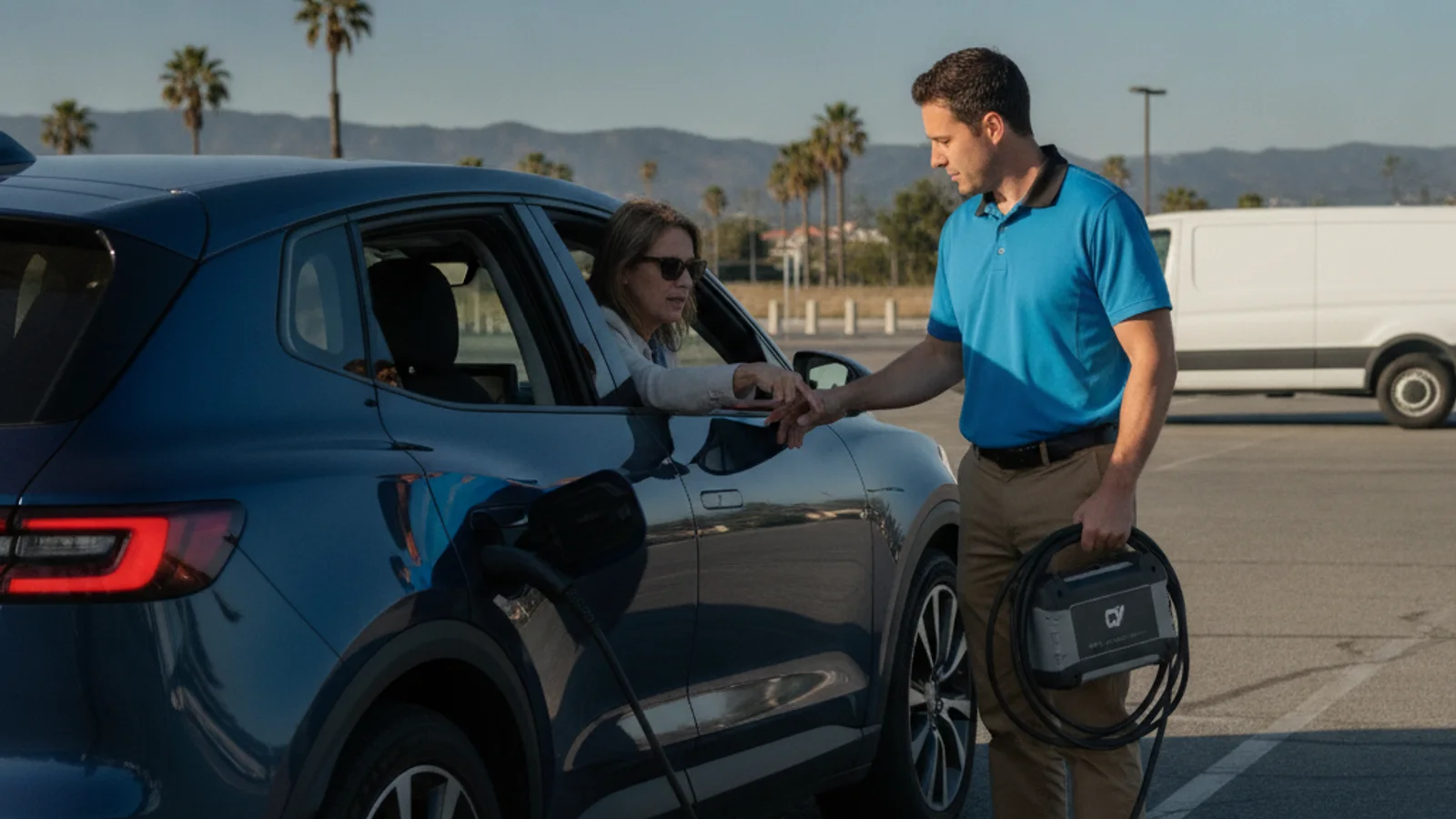
A charge fits when the traction pack is empty. The car also has to be reachable where it sits. Independent operators we connect you with can bring a Level 2 source to the car. Typical charging adds about 10 to 20 miles in 15 to 30 minutes. That’s charging time, never an arrival time. Details are on mobile EV charging.
A 12-volt jump or on-site replacement fits when the small battery failed. The manufacturer has to allow that work on your model. Some EVs have jump points in the frunk or behind a cover. Don’t copy a video shot on another make. Confirm the steps with the operator and the owner’s manual first.
Transport fits when the cause isn’t confirmed. It also fits when the car isn’t safely reachable. Some dash messages, per the maker, need a shop instead of a curb fix. CHP can dispatch a rotation tow for a disabled vehicle on the freeway. City of Los Angeles impounds go through Official Police Garages. Exact OPG fees and release steps couldn’t be confirmed for this page. Check lapdonline.org or lacity.gov before you assume a process. California doesn’t set one statewide tow rate.
If you can’t tell which battery failed, say that on the call. A matched operator would rather hear you’re not sure. A guess dressed up as a diagnosis wastes time. The wider split is in Your electric car died: charge it, jump the 12V, or tow it?.
Where your model’s details actually live
A general article can’t name your jump points or your exact warning text. Those change by make, model, and year. The current owner’s manual is the first place to look. Tesla, Rivian, Ford, Hyundai, and GM each publish their own 12-volt steps. Use those pages instead of a writeup for a different year.
If you need a local operator
Call when the EV won’t power on or won’t charge. Call when the warning on the dash doesn’t fit what you know. The matched operator will use your vehicle details and that exact message. They sort charging, a 12-volt jump, or transport from what they find on site. Call (858) 925-5546 and we’ll connect you with a local EV rescue operator. You contract with that operator, and you pay that operator.