A GMC Sierra EV that hits empty in Los Angeles County doesn’t need a tow as the first move. A mobile 240V Level 2 boost at the curb is how this truck adds 10 to 20 miles. That’s charging time of 15 to 30 minutes, never an arrival time. Charge Pro LA connects you with independent operators who bring the plug to you. The operator quotes you before any cable goes in, then bills you directly.
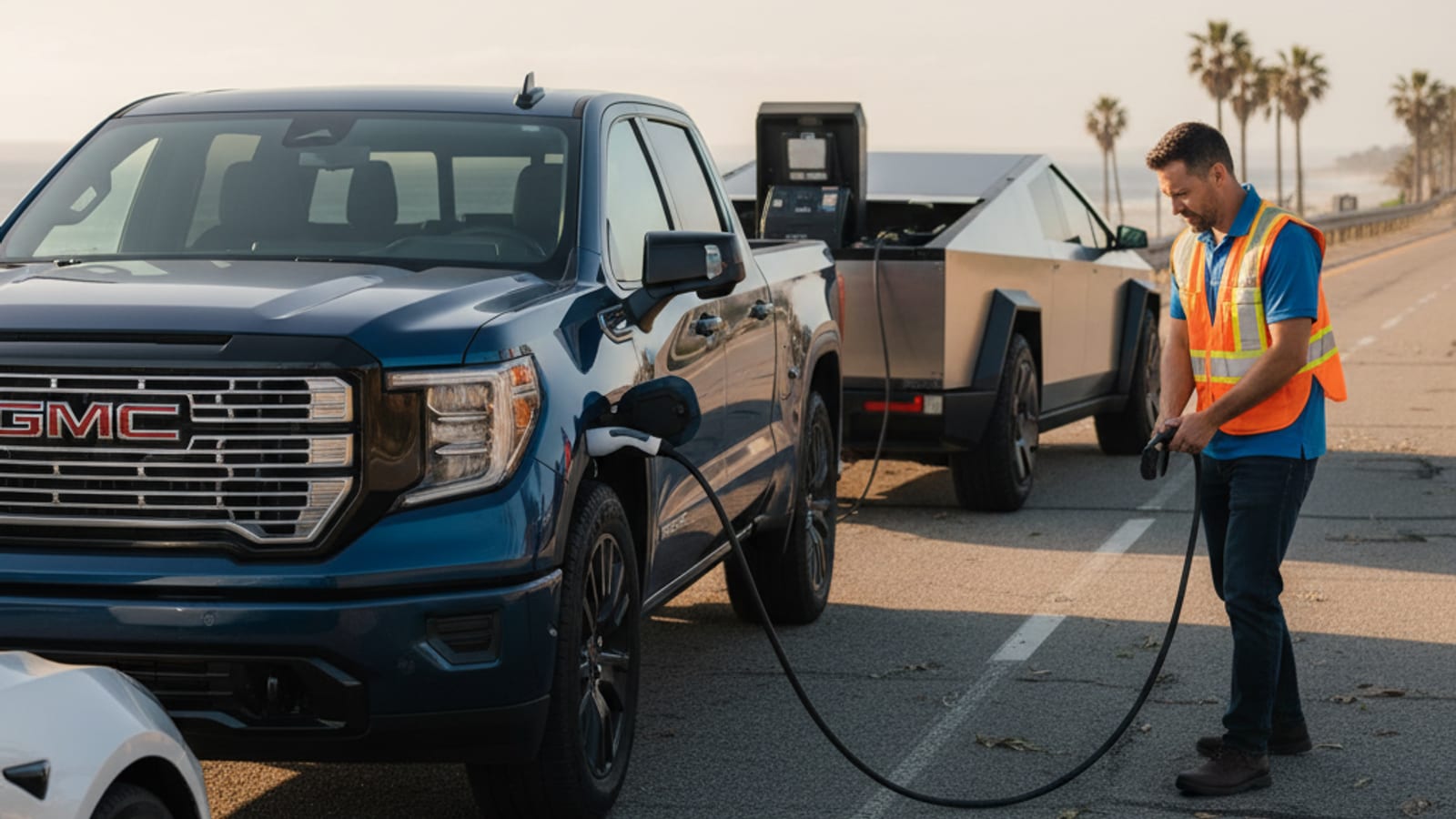
Empty on the 5 isn’t a mystery stall
The Sierra EV is a work truck with a large pack. In this county that pack still has to climb. You finish a drop near the Harbor and turn toward Santa Clarita. You leave a San Gabriel Valley job and take the 10 with a loaded bed. You come down the 14 from Palmdale after an Antelope Valley site day. Range that looked fine on a Westside boulevard can sag on a grade.
This is GMC Sierra EV emergency charging as it actually happens here. The truck isn’t failing because it’s exotic. It’s a heavy EV doing heavy work. Payload, speed, and hill load share one battery. Cabin AC on a hot Valley afternoon shares it too.
When the estimate falls apart, watch what the truck does. Power often fades before the wheels stop. The pedal feels dull. Top speed may be limited. Climate and extra screens may shut off to save propulsion. Some trucks still creep to a shoulder. Others stop in place. Get out of the travel lane as soon as you can.
Then decide what actually died. A drive pack at zero can still show a display for a while. Hazard lights may still work. Door handles may still answer. That’s an energy problem. A silent cabin with a dead fob and dark screens is often the 12V. The small battery runs computers, contactors, and locks. If it fails, the big pack can sit full and still leave you stuck. Tell the person you call which one you’re seeing. A jump on the 12V won’t fill an empty traction pack. A Level 2 boost won’t wake a truck that can’t close its contactors.
Shoulder rules that actually apply
Hazards on first. Then get the body of the truck out of the lane. On the 405, the 110, and the 10 that’s the whole first minute. Stay in the cab if the cabin is intact. If you must exit, walk beyond the shoulder and face traffic.
California Vehicle Code 21718 bans stopping on a freeway in ordinary driving. A disabled vehicle is an exception when you’ve summoned help. It’s also an exception when you must avoid injury or damage. An officer’s direction counts too. Calling for assistance puts you in that exception. Don’t wander up the on-ramp for a photo.
CVC 21809 is the move-over law. Drivers approaching a stopped emergency vehicle with flashing lights must move over. The same rule covers a tow truck or a Caltrans vehicle. They must change to a non-adjacent lane if it’s safe. If they can’t, they must slow to a reasonable speed. That law protects you. It doesn’t make the shoulder safe. Assume someone won’t move over.
Metro Freeway Service Patrol trucks roam congested LA County freeways. The program is a joint effort of Caltrans, CHP, and LA Metro. It’s free to motorists. Dial 511 and say Motorist Aid. Published FSP help includes a gallon of gas. It also covers a radiator refill, hose tape, and a tire change. It can tow you free to a CHP-chosen safe spot. Those materials don’t list mobile EV charging or a pack fill. An empty Sierra EV is outside that published list, other than a tow off the freeway. Hours are typically Monday through Friday in peak commute windows. There’s all-day coverage in some construction zones. Midday and weekend patrols exist on the busiest corridors. Confirm the current pattern on metro.net before you count on a truck.
Don’t leave the Sierra sitting unattended on a freeway. CVC 22651 lets an officer remove a vehicle that’s been unattended on a freeway for four hours or more. Other removal triggers include blocking traffic, expired registration over six months, and an arrest. CHP uses a rotation tow list for disabled freeway vehicles. Details of the local rotation weren’t confirmed in the research for this page. Ask the officer which yard if a hook is already assigned.
Parking structures and job-site lots follow CVC 22658. A private-property tow needs the required 17 by 22 inch signs at the entrances. It needs written authorization from the owner or agent. The tow company must notify local law enforcement within one hour. If you return before the truck leaves the lot, it must be released immediately. California doesn’t publish one verified statewide cap for that bill. Confirm the current charge with the lot and the city before you pay.
Metro ExpressLanes run on the I-10 through El Monte and on the I-110 Harbor Freeway. A FasTrak transponder tied to a funded account is how you enter. A vehicle without one is billed by plate under Pay-As-You-Go, plus a processing fee. Motorcycles are exempt. If your Sierra stops inside an express-lane segment, treat it as a disabled vehicle and call for help. Metro’s published FAQ doesn’t spell out a unique disabled-vehicle procedure for those lanes. Stay with the truck and follow CHP if they arrive.
Why this county spends the pack faster than the sticker
GMC publishes a range number for a light, mild day. Los Angeles County isn’t that day. The truck is tall and heavy. Work loads make it heavier. The roads here aren’t flat for long.
North county is a climb story. The Grapevine north of Castaic is the long grade that defines EV range in this metro. You’re not hopping a freeway overpass. You’re feeding motors for miles. Regenerative braking helps on the way back down. It doesn’t refund the whole climb. Pair that with cabin cooling and the estimate drops in a hurry. If you’re heading that way on a low pack, pause first. Here’s what to do on the 5 near Santa Clarita.
Sepulveda Pass on the 405 is the Westside-to-Valley tax. It’s shorter than the Grapevine. It’s still a real climb between the basin and the San Fernando Valley. A Sierra EV that left Culver City with a thin buffer can feel that pull. The same truck on surface streets in South Gate or Huntington Park is a different day.
The 10, the 60, and the 57 add heat and freight speed through the San Gabriel Valley. High speed costs energy. Pomona, West Covina, El Monte, and Pasadena don’t drive like the beach. Pasadena’s 210 and 110 junction is stop-and-go, then hills toward the foothills. Azusa and Glendora sit against those grades.
The Antelope Valley is climate. Lancaster and Palmdale see hard summer heat and cold winter nights. Recurrent Auto’s testing across more than 30 EV models found about 78 percent of range left at 32F. At 20F the average was about 70 percent. Individual models lost anywhere from about 16 percent to about 46 percent. Cabin heating was the main driver. Recurrent also reports that summer heat and heavy air conditioning reduce range. A heat pump extended cold-weather range by roughly 10 percent at 32F versus a resistive heater. Those figures aren’t GMC’s sticker. They’re published test averages. Use them as a warning, not a promise for your truck. Specific Lancaster and Palmdale station normals weren’t attached to this research. The pattern is still clear. Antelope Valley heat and a running HVAC system shrink real miles.
The coast is milder, not magic. Santa Monica, Redondo Beach, Manhattan Beach, and Malibu sit in marine-layer months. NWS Los Angeles/Oxnard calls that pattern May Gray and June Gloom. That air is cooler than Glendale or Burbank on the same afternoon. Santa Ana winds can erase that comfort countywide when they blow. PCH through Malibu still has hills. Treat coastal miles as real miles.
Accessory load is easy to ignore in a Sierra EV. The truck is built to work. Powering tools, a fridge, or lights from the bed draws energy. GMC’s ProPower Onboard system feeds AC loads. It isn’t a designed way to fill another EV’s traction battery on the shoulder. A second EV usually can’t rescue you either. See Can one EV charge another.
Driving style still matters. Hard launches from a Commerce warehouse light cost more than a smooth roll. Highway speed on the 91 through Compton costs more than a 35 mph street in Alhambra. A loaded bed after a Carson stop costs more than an empty weekend ride in Beverly Hills. Watch the energy screen while you still have a buffer. Arriving with 10 to 20 percent left is a habit, not a superstition. Detours, traffic, and a closed stall eat that buffer.
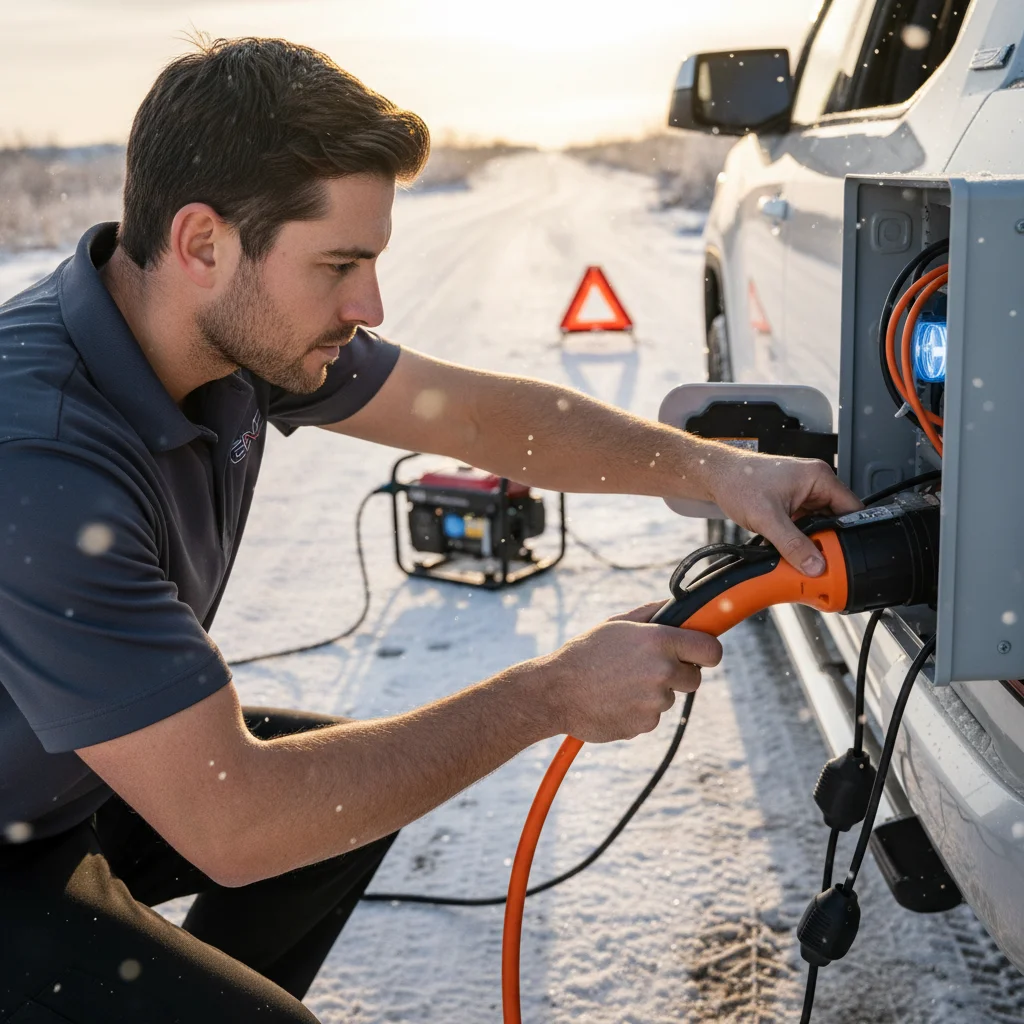
What a mobile Level 2 boost actually does
Public DC fast charging is a stall you drive to. A mobile boost is the other direction. An independent operator brings a 240V Level 2 source to the Sierra EV. Charge Pro LA doesn’t own that truck. It doesn’t employ the technician. It matches you with a local pro. The pros we connect you with are licensed and insured. They quote before they start. They bill you directly.
The hardware is simple on purpose. Operators bring a native NACS plug, plus a CCS or J1772 adapter for non-Tesla EVs. The Sierra EV uses CCS for DC fast charging and for AC charging at public posts. On the roadside, the adapter is how a NACS-native rig talks to your port. You don’t need to carry the adapter yourself for this call.
What you get isn’t a full pack. The usual on-site result is a 10 to 20 mile add in 15 to 30 minutes of charging. That’s enough to roll to a public stall, a lot you’re allowed to use, or home if you’re already close. It isn’t a fill to 80 percent. It isn’t a Supercharger session. For the difference between levels, see what a Level 2 boost adds. To see how the visit works, start with mobile EV charging.
Tell the operator your exact place. Freeway mile marker, exit name, structure level, or a cross street in East Los Angeles all work. Say it’s a GMC Sierra EV. Say CCS. Say whether the dash is alive. Say whether you can shift to park and open the charge port. A port that won’t unlatch is a different job than an empty pack.
If the 12V is the failure, charging the traction battery may not be step one. The truck may need a 12V jump or a replacement at the curb first. That’s still on-site work. It isn’t a tow by default.
A portable 120V cord isn’t a freeway plan. You’d need an outlet you’re allowed to use, and you’d sit a long time. The mobile operator brings the 240V source with them.
If the truck can still roll
If limp mode still moves you, a public CCS stall can be the whole fix. Use the truck’s nav. Use PlugShare or another map you already trust. Filter for CCS. Confirm the stall is online before you spend the last miles. The DOE Alternative Fuels Data Center at afdc.energy.gov is a public place to look up stations. This page doesn’t estimate how far your nearest stall is. Distances like that weren’t verified here.
Los Angeles International Airport is one place the research did confirm stalls. LAX terminal structures P1 through P7 offer Level 2 and DC fast charging. The Economy Parking garage has more than 4,000 stalls, including 514 active EV chargers. That still doesn’t save a traveler who returns to a dead 12V. A week in a lot can kill the small battery even when chargers sit in the same garage. A 12V failure isn’t an empty pack. Don’t plug a DC cord into a brick that won’t wake. Diagnose first.
If you can’t roll, don’t hunt a stall on foot along a freeway. Call for a mobile boost or a recovery. Out-of-charge recovery is the service path for a pack at zero. Non-Tesla EV rescue is the path that assumes CCS or J1772.
Why a tow is the last call for this truck
A Sierra EV is long, heavy, and not a flat-tow hobby. Drive wheels and an unpowered pack don’t love being dragged. A flatbed is the usual safe method. That means waiting on a bed, loading a full-size pickup, and still charging at the other end. If the destination is a busy dealer, you may wait again for a stall.
Towing has a place. Mechanical damage, a crash, or a truck that can’t accept a charge still needs a bed. An empty pack by itself usually doesn’t. A tow still gets messy here. Read why towing a dead EV hurts in this county.
City of Los Angeles impounds run through Official Police Garages. Release needs proof of ownership, an LAPD release when it applies, and payment of tow and storage. The exact OPG steps and fee schedule weren’t verified here. Confirm on lapdonline.org or lacity.gov before you treat any step as fixed. Don’t use a street-parked wait as your plan on a freeway. Four hours unattended is already a removal window under CVC 22651.
Home charging won’t meet you on the 405
Daily charging still belongs at home. Rescue is the backup when the day ran long. Los Angeles County has no single electric utility. That matters for your bill. It doesn’t change who can charge you on the shoulder.
The City of Los Angeles is LADWP territory. LADWP is the largest municipal utility in the United States. It publishes a Residential EV Charger Rebate Program toward a Level 2 home charger and a dedicated EV meter. It publishes a Used Electric Vehicle Rebate Program. It also has a dedicated EV time-of-use rate that needs a separate EV meter. Those rates are listed among EV, NEM, and REO plans. Amounts on those pages aren’t repeated here. Confirm the current rebate and rate with LADWP before you pay or enroll. Start at ladwp.com.
Most of the rest of the county is Southern California Edison territory. SCE publishes Charge Ready Home toward a Level 2 install. It publishes a Pre-Owned EV Rebate for buying or leasing a used EV. It publishes EV rate plans on its rebates and rates hub. Confirm current terms on sce.com. This page doesn’t publish a per-kWh figure.
Many SCE cities buy generation through Clean Power Alliance. CPA was founded in 2017 and serves 38 communities. SCE still delivers the power, maintains the lines, and reads the meter. You see two line items. CPA membership doesn’t change a roadside rescue. It does mean you shouldn’t assume a pure SCE generation rate. Santa Monica, Culver City, Malibu, and unincorporated Los Angeles County are among the member communities.
Some cities run their own power utilities. Glendale Water and Power serves Glendale. Burbank Water and Power serves Burbank. Pasadena Water and Power serves Pasadena. Azusa Light and Water serves Azusa. Name the utility on your bill. Don’t assume an SCE or LADWP rebate applies there. Specific EV program names for those four weren’t verified against each utility’s own site for this page.
A Level 2 wall unit at home is still the habit that keeps a Sierra EV out of limp mode. Time-of-use plans shift when the truck should charge. They don’t send a truck to the 10. If the panel in an older house can’t take a new circuit, that’s an electrician conversation. East Los Angeles, Huntington Park, and Whittier have large shares of pre-1980 housing in Census ACS data. An old panel is common in those places. It still isn’t a reason to guess a mobile-charging price.
Where Sierra EV drivers actually get stuck
Work trucks stall where work is. The East LA Interchange funnels the 5, the 10, the 60, and the 101. Commerce sits on the industrial belt. Huntington Park and East Los Angeles are dense and older. Plan the pack like a workday.
Harbor and South Bay miles mix freight and grades. Long Beach, Carson, and Torrance run port-adjacent roads. Rancho Palos Verdes has peninsula hills. Inglewood has stadium parking that can sit for hours. A 12V that dies in a structure is the same failure as an airport lot.
Westside jobs still climb. Santa Monica, Culver City, and El Segundo feed the 405. Sepulveda Pass is the tax out of that basin. The San Fernando Valley adds heat. Glendale, Burbank, Calabasas, and Agoura Hills don’t drive like each other. Canyon roads start at the west end of the Valley.
North county is the Grapevine approach. Santa Clarita, Stevenson Ranch, and Castaic sit on that I-5 gate. The Antelope Valley adds heat and cold on the 14 through Lancaster, Palmdale, and Acton. The San Gabriel Valley stacks the 10, the 210, and foothill streets. Pasadena, El Monte, Pomona, and Azusa each mix heat and hills. Gateway Cities like Downey, Compton, and Whittier are loaded-bed days. Malibu and Topanga are coastal mountain roads. Get out of the lane if you can.
What actually moves the quote
Charge Pro LA doesn’t set the price. The operator does. Distance across this county is the first lever. A boost in Culver City isn’t the same dispatch as one in Lancaster. Time of day matters because traffic and labor windows change. How much range you need matters too. Ten miles to a stall you can already name isn’t the same session as a longer top-up toward home. The operator quotes you before starting. If the number doesn’t work, you can decline. No cable goes in on a mystery bill.
Don’t use a blog to guess a figure. No verified operator rate for this metro is published here. Confirm the quote on the call.
GMC’s own roadside is a different product
Many new Sierra EVs include a period of manufacturer roadside help. The length, mileage cap, and included tasks weren’t verified for this page. Read the plan that came with your truck. Call GMC’s published roadside channel if that’s the path you want. Manufacturer programs often default to a tow. A tow still leaves you needing electrons. Local mobile rescue is the plug-at-the-curb path. It isn’t a GMC claim, and Charge Pro LA isn’t GMC.
Keep software current. GMC pushes battery and charging updates. Follow the maintenance schedule in the owner’s materials. That’s prevention. It isn’t a rescue.
Frequently asked questions
What changes the quote for GMC Sierra EV emergency charging?
Where you are, when you call, and how many miles you need. Los Angeles County is large. Antelope Valley, the Harbor, and the Westside aren’t one dispatch. The operator quotes before any charging starts and bills you directly. Charge Pro LA doesn’t set that number. Confirm it on the call. No figure on this page would stay true across cities and hours.
How much range does a mobile Level 2 session add?
Operators typically add 10 to 20 miles in 15 to 30 minutes of charging. That’s charging time on the curb. It isn’t a promise of when the truck arrives. The goal is enough range to reach a stall or home if you’re close. It isn’t a full charge. Efficiency, cabin load, and grade after you leave all change how far those miles go.
Can another EV charge my stranded Sierra EV?
Don’t plan on it. Some EVs advertise bidirectional power. It isn’t a standard roadside method. The Sierra EV’s ProPower Onboard outlets feed tools and AC loads. They aren’t a practical way to fill another EV’s traction pack. They also aren’t a way to take a pack fill from a passerby. A dedicated mobile Level 2 source is the on-site option.
If you’re empty now, call Charge Pro LA at (858) 925-5546. We’ll connect you with a local operator who can quote a 240V boost on the spot. We serve every city in Los Angeles County. The operator performs the work. We don’t.