An ev rapid charger near me result is a pin, not a plan. On a Los Angeles County freeway, that hunt often ends on the shoulder. Metro Freeway Service Patrol lists gas, a tire change, and a free tow. It doesn’t list mobile EV charging. If remaining range can’t cover the full route, stop chasing the pin. Stay put and get help to the car.
Confirm the stall before you spend remaining range
A search result is a starting point. Station status, access rules, and connectors change. Confirm those details before you spend the last miles.
Open the station operator’s own app or site. Compare that with your car’s navigation. An aggregator map can show options. It can’t prove the stall works tonight.
Check these items before you commit:
- The connector matches your vehicle.
- The operator shows the stall as available.
- You can enter the property when you arrive.
- The stall isn’t limited to customers, residents, or employees.
- Your car predicts enough energy for the full route, including ramps.
- You can see the current session price before you start.
The US Department of Energy charging guide names the DC fast-charging plugs. CCS, CHAdeMO, and J3400 are the types it lists. Your EV may not accept every one. An adapter doesn’t make every stall compatible.
Live status is a signal, not a reservation. Another driver can take the stall before you arrive.
If you still have planning range, review these EV charging apps to check before you’re stranded. Save more than one compatible stall along the same route. Don’t hop from one uncertain pin to another on empty.
Why Metro FSP isn’t an EV charger
Straight-line distance isn’t the route. On I-10, I-110, I-405, I-5, or the 14, exits still cost range. Surface streets and lot ramps do too.
California Vehicle Code 21718 generally bars stopping on a freeway. A disabled vehicle is an exception when you’ve summoned help. Calling for assistance puts you in that exception. It doesn’t make the shoulder safe.
CVC 21809 is the move-over law. Drivers approaching a stopped emergency vehicle, tow truck, or Caltrans vehicle with flashing lights must move over. If they can’t change lanes, they must slow to a reasonable speed. Keep hazards on and stay with the car. CVC 22651 lets an officer remove an unattended freeway vehicle.
Metro Freeway Service Patrol is a joint program of Caltrans, CHP, and LA Metro. It’s free to motorists on congested county freeways. Dial 511 and say Motorist Aid. Published help includes a gallon of gas. It includes a radiator refill and hose tape. It includes a flat-tire change. It includes a free tow of a disabled vehicle to a CHP-chosen safe spot. Hours are typically weekday peak commute periods. Confirm current hours on metro.net.
The published motorist-assistance list is written for gasoline cars. It doesn’t name mobile EV charging. It doesn’t name an out-of-charge pack fill. That’s an observed absence from metro.net and chp.ca.gov as of September 18, 2026. It isn’t a claim about unpublished FSP policy. An empty EV can still get the free tow off the live lanes. That tow doesn’t put miles back in the battery.
Metro ExpressLanes run on I-10 and I-110. A FasTrak transponder tied to a funded account is required to enter. If you stall there, treat toll billing as a separate Metro process. Don’t invent a disabled-vehicle procedure Metro hasn’t published.
If the car is already in a travel lane, call 911.
Westside, Valley, East County, and the desert commute
Los Angeles County isn’t one charging map with the city name swapped. Coastal Westside and the San Fernando Valley drive differently. East County, the South Bay, and the Antelope Valley do too.
Santa Monica’s ACS 2019-2023 population is 91,535. Culver City is 39,993. Those Westside cities sit under the marine layer. NWS Los Angeles/Oxnard calls it May Gray and June Gloom. The Valley on the other side of Sepulveda Pass does not.
Glendale’s ACS population is 192,270, and Burbank is 105,165. The 405 climb between those climates is a commute, not a road trip. Recurrent Auto’s published tests across 30-plus models found about 78% of range at 32F. Cabin heat was the main drain, and summer AC cuts range too.
East Los Angeles has an ACS population of 114,617. The East LA Interchange stacks the 5, the 10, the 60, and the 101. A map pin across that stack can look close.
Long Beach has an ACS population of 458,491. Torrance is 143,499. South Bay lots mix street stalls and garage stalls. Confirm the garage entrance, not just the pin.
Lancaster’s ACS population is 170,013. Palmdale is 165,487. Both sit in the Antelope Valley, where heat and cold cut range below the sticker. Santa Clarita’s ACS population is 229,021. It’s the last basin stop before the I-5 grade north of Castaic. Don’t spend remaining energy on a pin you haven’t confirmed.
The City of Los Angeles is LADWP territory. Most of the rest of the county is Southern California Edison territory. Clean Power Alliance buys generation for Santa Monica, Culver City, Beverly Hills, Malibu, and West Hollywood. SCE still delivers the power and reads the meter. That split doesn’t change a roadside rescue. Confirm current public-stall rates with the station operator. This page doesn’t publish a dollar figure.
For a county map of service pages, start at EV charging in Los Angeles County. For corridor-specific next steps, use out of charge on the 405 at Sepulveda Pass.
Empty pack, dead 12V, or a stall that won’t start
Treat dashboard range as an estimate. Add the exit, local turns, garage ramps, and the lot entrance. If that full path leaves no buffer, stop.
First, check whether the EV is still acting like itself. A locked charge port can mean a public stall won’t help. Read the exact dash message.
A dark screen and locked doors don’t prove the traction pack is empty. The 12-volt battery runs the computers that close the contactors on the main pack.
LAX is the named example. Terminal parking structures P1 through P7 all offer Level 2 and DC fast charging. The LAX Economy Parking garage lists more than 4,000 stalls, including 514 active EV chargers. A traveler can still return to a dead 12V after a week in those lots. That job is a jump or a 12V replacement on site.
If a public stall is connected but not charging, stop guessing. Work through public EV charger not working: what to do.
When a mobile Level 2 boost is the better call
Mobile charging can fit when the car is parked safely and the pack is depleted. The usual goal is enough range to reach a place you choose.
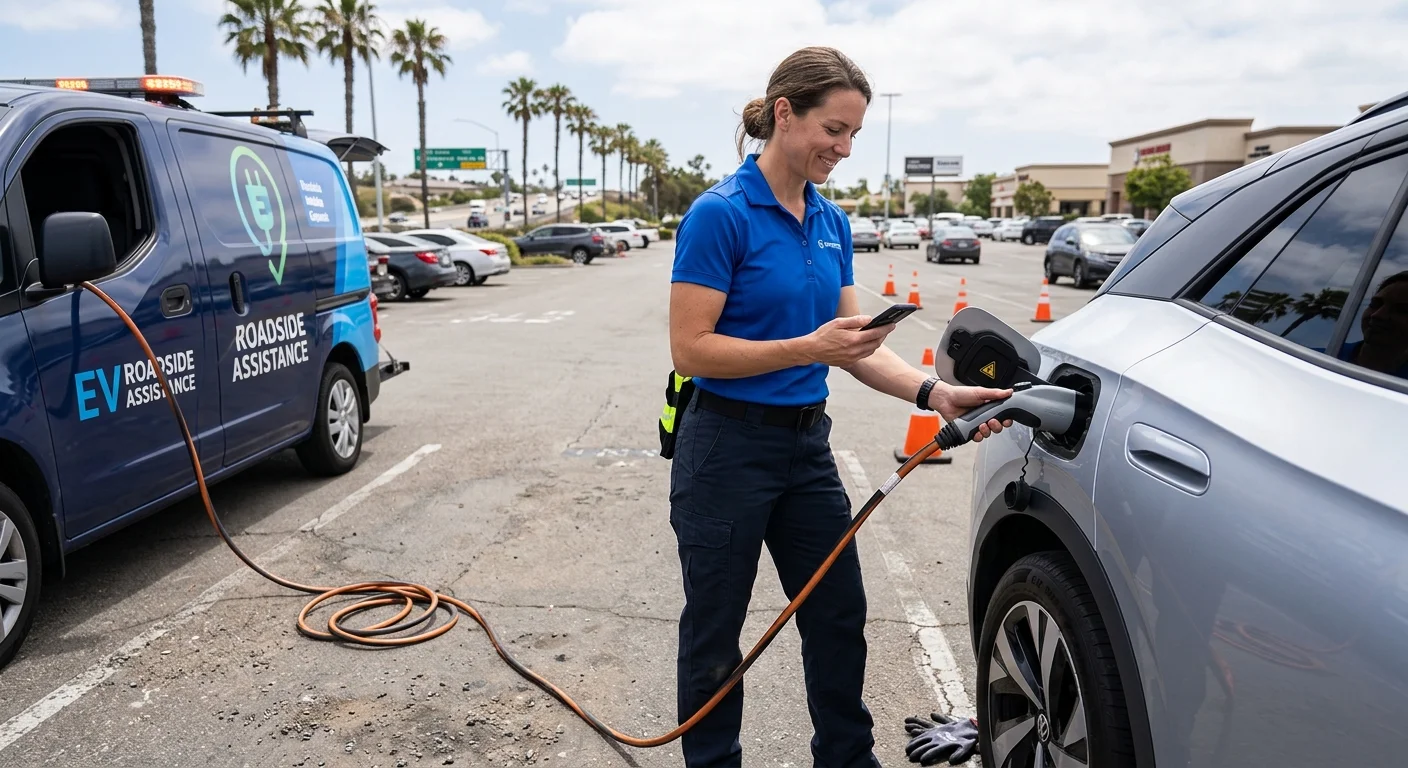
The operators in this network bring a 240V Level 2 source to the car. Tesla owners get a native NACS plug. Other EVs use a CCS or J1772 adapter. Typical charging time is 15 to 30 minutes. That usually adds about 10 to 20 miles of range. That’s charging time, never an arrival time. Operators also jump or replace a dead 12V on site.
Charge Pro LA is a referral line. We match stranded drivers with independent local mobile rescue operators. We perform no work, own no trucks, employ no technicians, and set no prices. We promise no arrival window, publish no hours, and hold no license. The operator quotes you before starting and bills you directly. The pros we connect you with are licensed and insured. We serve every city in Los Angeles County.
Before you request mobile EV charging, collect what the operator needs:
- Year, make, and model
- The exact dashboard message
- Current battery percentage, if the screen shows it
- Visible connector or charge-port type
- Precise location and parking position
“Downtown” isn’t enough inside a garage. On a freeway, give the route, direction, and a nearby exit.
Mobile charging may not fit if the car won’t accept power. It may not fit if the charge port is damaged. It may not fit if the 12V keeps the car locked. Describe the symptoms. Don’t guess the cause.
When a tow is the honest next step
Transport can fit when charging won’t fix the immediate problem. If every confirmed compatible stall sits beyond remaining range, stop driving toward the pin.
FSP’s free tow to a CHP-chosen safe location is the published freeway option. California doesn’t set one statewide tow rate in the materials we checked. Confirm the current figure with the yard before you pay.
Out-of-charge recovery connects you with an independent local operator. Charge Pro LA doesn’t tow vehicles or set operator pricing. If transport is recommended, follow the vehicle maker’s towing instructions.
Call when the pin is no longer reachable
Call when your EV can’t safely reach a confirmed rapid charger. We’ll connect you with an independent local operator. See what Los Angeles County EV drivers should do when stranded for the wider county fork.
Call (858) 925-5546 and we’ll connect you with a local EV rescue operator.