A Ford Mustang Mach-E won’t start in a parking structure. In Los Angeles County, the 12V usually failed to wake the car. The big drive pack can still be full. The screens stay dark. The fob may not even unlock the doors. This is the usual story after a long sit at LAX. It’s the same after a SoFi Stadium event.
The 12V is what actually wakes a Mach-E
Your Mach-E still has a small 12V battery, same idea as a gas car. That battery runs the computers, locks, and lights. It also runs the switches that connect the high-voltage pack. Those switches are the contactors. If the 12V is flat, the contactors never close. The car can’t wake, charge, or hear the fob. A full traction pack sits there unused.
A low drive pack looks different. The cabin often still powers on. You may see a low-charge warning. Drive may stay locked out. You might get a reduced-power note. A blank cabin is the 12V signature. A flicker and a click behind the dash point the same way.
There’s more on that brick-like state in what happens when an EV 12V dies.
Parking structures around the county
Travelers leave a Mach-E in LAX terminal structures P1 through P7 for days. Those garages offer Level 2 and DC fast charging. The LAX Economy Parking garage lists more than 4,000 stalls. That count includes 514 active EV chargers. None of that wakes a dead 12V. Modules that stay half-asleep drain the small battery. It isn’t an empty pack.
The same sit happens after a flight through Hollywood Burbank Airport or Long Beach Airport. Charging layouts at those two fields weren’t confirmed for this page. The 12V-after-a-trip pattern still applies. Studio lots in Burbank see it after a long shoot day. Inglewood event parking sees it after a night at SoFi. Griffith Observatory and Universal Studios Hollywood add long, quiet soaks in structures. Culver City, West Hollywood, and Santa Monica garages do the same overnight.
If you’re on private property, read the tow signs. California Vehicle Code 22658 sets the private-property tow rules. A lot needs the required 17-by-22-inch entrance signs. It also needs written authorization from the owner or agent. They must notify local law enforcement within one hour. If you return before the car leaves the lot, they have to release it. At most half the tow charge applies if it’s coupled but not yet moved. Storage rates can’t exceed law-enforcement-approved rates. Confirm the posted rules on that garage’s own signs. City of Los Angeles Official Police Garage fees weren’t verified here.
What the dash is trying to tell you
A Mach-E with a little 12V left may still flash a line. Read it before you assume the pack is empty.
System Off to Save Battery usually means the 12V is fading. A countdown to shut down points the same way. The car is holding a last bit of control power.
Key Fob Not Detected can be a dead coin cell in the fob. It can also be a weak 12V that can’t power the receivers. Swap the fob battery first if you’ve got a spare.
Stop Safely Now is a heavier warning. It often points past a simple 12V drain. Don’t keep trying to drive on that one.
Service Vehicle Soon is a general flag. It doesn’t always block a start. It still needs a shop if it stays on.
A fully blank display is the classic dead 12V. There’s nothing left to draw a warning.
Find the 12V in the frunk
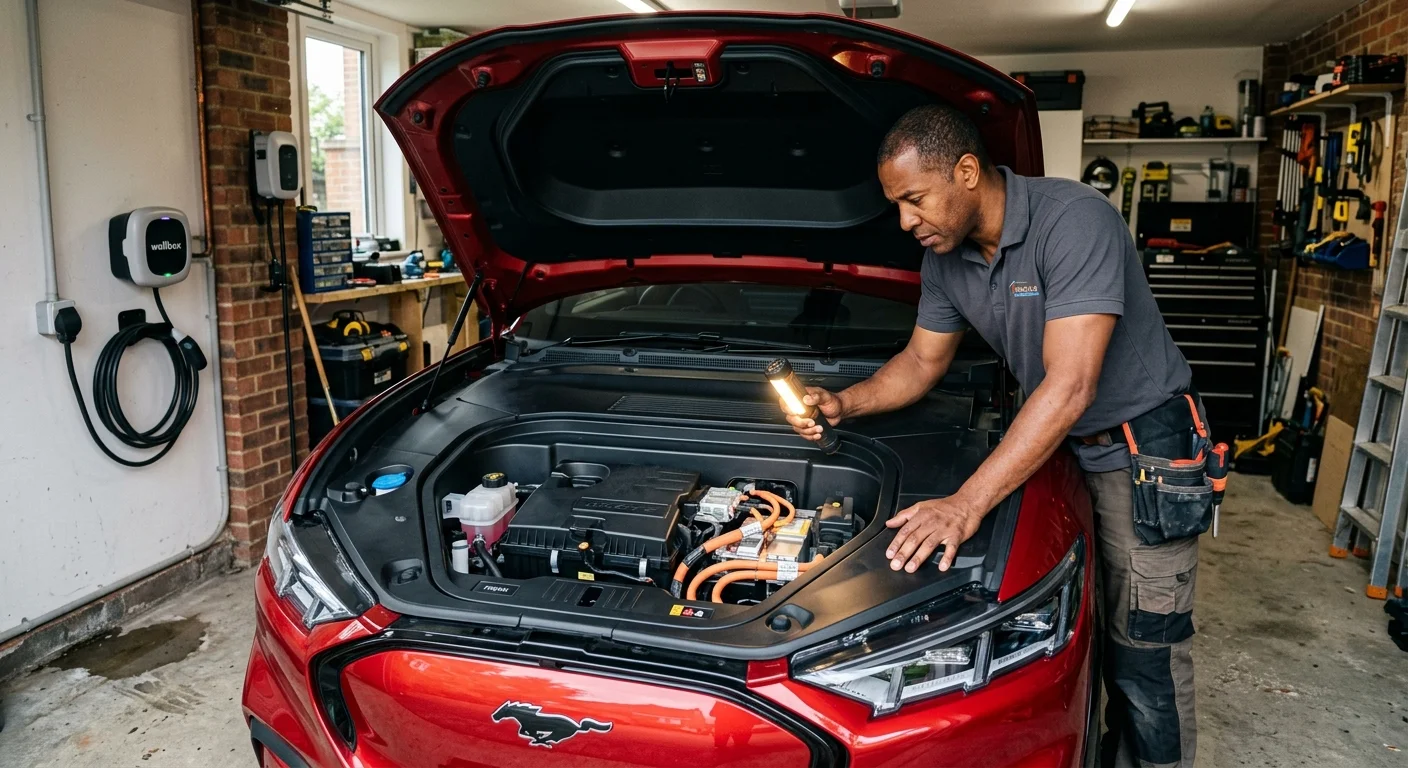
Ford puts the Mach-E 12V under the hood, in the front trunk. That isn’t the high-voltage pack. You’re only looking at the small battery.
Use the fob or the interior release to open the frunk. On the passenger side you’ll see a plastic cover. Clips or fasteners hold it. Pull those carefully. The 12V sits under that cover. It looks like a compact car battery.
A multimeter on DC volts is the clean check. Red probe on positive. Black probe on negative. A healthy rest voltage sits near 12.6 volts. A reading under 12 volts means the 12V is discharged or failing. Near 11.5 volts or lower is a strong tell. Confirm the spec in your owner’s manual. A low reading can still take a jump. A battery that dies again after a jump is usually due for replacement. That repeat pattern is in EV battery dies again after a jump.
Jump the 12V, never the drive pack
You’re not jumping the high-voltage battery. You’re only feeding the 12V system. Ford gives you jump posts in the frunk. You don’t have to clamp the battery itself. Look for a positive post under a red cap. The negative is a bare metal ground nearby, often a bolt or bracket.
Keep both vehicles off before you clip on. Use a jump pack or another 12V vehicle. Clamp red to the Mach-E positive post first. Clamp black to the Mach-E ground point. Then connect red and black on the donor side. Take the cables off in reverse order. Your owner’s manual is the last word on clamp points.
If the Mach-E wakes, keep it on. Plug in if you can. The car’s DC-DC converter can refill the 12V from the traction pack. That happens once the contactors close. A jump that fails twice is a replacement job, not another clamp. For clamp order in plain steps, see how to jump start an electric car.
Do this only if you’re comfortable around a battery. If the frunk won’t open, or the posts aren’t obvious, stop. A lot of Mach-E no-starts in county garages end here. The owner can’t get a cable on. A mobile operator jumps the 12V on site instead.
Empty pack or dead 12V
A Mach-E that powers on but won’t move may be out of traction charge. That’s a different call. Charge Pro LA connects you with independent local operators. Those operators can bring a 240-volt Level 2 source to the car. They use a CCS or J1772 adapter for a Ford. That boost typically adds 10 to 20 miles of range. The charging itself takes 15 to 30 minutes. That’s charging time, not a promise of when someone arrives.
A dark Mach-E with a healthy indicated pack doesn’t need that boost first. It needs the 12V jumped or replaced on site. Operators we connect you with handle both. They quote you before they start. They bill you directly. Charge Pro LA doesn’t own trucks and doesn’t send employees. It matches stranded drivers with local mobile rescue operators across Los Angeles County.
If the car is truly empty, a tow is the last option. Use a flatbed if you must tow. Do that only after a 12V wake or a mobile boost is off the table. More on that fork is in charge it, jump the 12V, or tow it.
Freeway stall versus a garage stall
A structure stall is slow and awkward. A freeway stall has extra rules. California Vehicle Code 21718 bars stopping on a freeway. A disabled vehicle is an exception once you’ve summoned help. Stay out of live lanes. California Vehicle Code 21809 is the move-over law. Other drivers must change lanes if they can do it safely. Otherwise they have to slow to a reasonable speed.
Metro Freeway Service Patrol is free on congested county freeways. Dial 511 and say Motorist Aid. Coverage is typically weekday peak hours, plus more on some busy corridors. FSP’s published list covers a gallon of gas. It also covers a radiator refill, a taped hose, and a tire change. It can tow you at no charge to a CHP-chosen safe spot. It doesn’t list mobile EV charging or a 12V jump for an asleep EV. Treat that as an observed gap in the published materials. An FSP truck can still move you off the freeway. It won’t charge the Mach-E.
Metro ExpressLanes on the I-10 and the I-110 need a FasTrak account. A disabled-vehicle procedure inside those lanes wasn’t published in Metro’s FAQ. Don’t sit in an express lane hoping for a charge.
Event garages are their own mess. After a SoFi game in Inglewood, the structure empties slowly. EV dead after a SoFi Stadium parking walks that scene. Downtown towers have the same dark-screen morning. See mobile EV charging in downtown Los Angeles parking garages. For a Ford that isn’t a Tesla, start with non-Tesla EV rescue.
After the Mach-E wakes
Once the 12V is up, keep the car on. Drive it or plug it in so the DC-DC can refill that small battery. In the City of Los Angeles, home power is LADWP. Most of the rest of the county is Southern California Edison territory. Pasadena, Glendale, Burbank, and Azusa run municipal power utilities.
When to get a local operator on the phone
Skip the DIY jump if the frunk is stuck. Skip it if Stop Safely Now is on the screen. Skip it if you’re on a narrow garage ramp and can’t work safely. The pros we send can jump or replace the 12V on site. They can also deliver that Level 2 boost if the pack is actually empty.
Call (858) 925-5546 and we’ll connect you with a local operator. The operator quotes before any work starts. You pay that operator directly.